[ad_1]

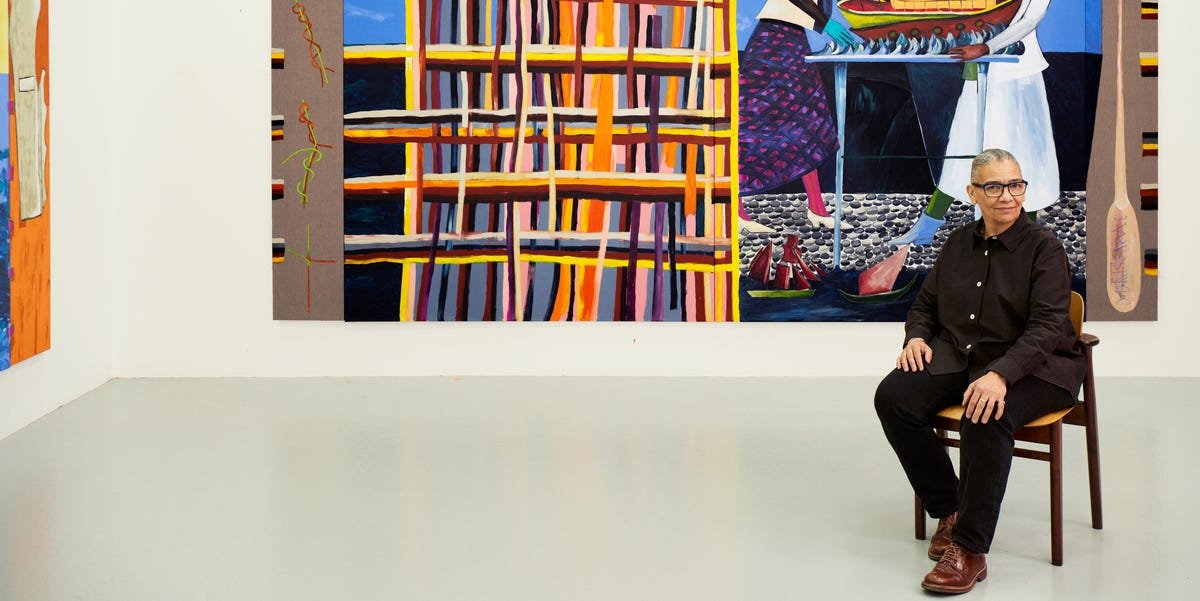
Lubaina Himid and ‘Is Water Always Useful’ (2025), on left, and ‘Man in a Rope Drawer’ (2025), right
17 January 2025, Beijing
Lubaina Himid is keeping a secret.
We are in China for the opening of her first ever solo exhibition in the country – a survey at the Ucca Center for Contemporary Art that features some of her greatest hits. Among them is Naming the Money (2004), which brings the invisible to the fore through 100 life-size cut-out Black characters – ceramicists, viola de gamba players, shoemakers – who were conventionally peripheral, but are now all named and given complex interior lives.
The figures are quintessential Lubaina Himid: theatrical, compelling, asking questions of the viewer; impressive in their individuality but also in their collective number. The show is a huge moment for the artist, and for British creativity in Asia.
But unbeknown to all there, just before Christmas the 70-year-old received a significant telephone call: an invitation to represent Great Britain at the world’s most prestigious artistic stage, the Venice Biennale, and take over the British Pavilion. Of course, she accepted.
At the celebratory dinner that evening at a fantastic restaurant in the hotel, Himid and I are having a chat about Zanzibar, the place of her birth. After her father died (he was from the Comoro Islands off the coast of East Africa), her mother took her back to London when she was four months old. “We left under traumatic circumstances,” she tells me. “My mother didn’t really talk about it.” Zanzibar has loomed large in her life as a place that has been difficult to return to. “I became frightened of going back for childish but real reasons, of belonging to the wrong set of people. In preparation, I tried to experience it through other means: Zanzibar through Venice. I used the city as a way to practise being out of my comfort zone; to learn the behaviours of not getting upset or feeling lost, a bit like using a supermarket car park to learn how to drive. Venice is nice, easier to digest.”
Perhaps the Venice Biennale is a homecoming, of sorts.

Himid’s former studio in her Preston home
15 August 2025, Preston
It’s a beautifully sunny day, and Himid is worried that Preston, her home city now for more than 30 years, is giving me the wrong impression. I’d just walked past the neoclassical Harris museum and art gallery, closed for refurbishment at the time, but looking majestic, bathed in a warm white light. ‘It’s not usually like this,’ she assures me over a cup of tea in one of her studio spaces, a former escape-room complex now fitted with museum-quality lights.
Himid – a key figure of British art and a cultural activist who has dedicated herself to uplifting marginalised narratives – has been ready for the Biennale for a good while. Sonia Boyce and John Akomfrah, who represented Great Britain at Venice in 2022 and 2024 respectively, are artists she has known well for more than 40 years. However, she hasn’t exhibited there in any capacity, even outside a national pavilion. Although she won the Turner Prize in 2017, at 63, the oldest person to do so, there are gaps in her career where she feels she has missed out on incremental steps. “Before showing at Tate Modern, theoretically and logically, you should have solo shows at galleries such as Serpentine, Whitechapel, Hayward and Tate Britain,” she says. “I went extremely slowly, then fast-track. So with Venice, there have been British and Black British artists in the main exhibition over the past 20 years, and that participation eluded me. Then suddenly I’m representing Britain in the same way that Jeremy Deller, Cathy Wilkes and Chris Ofili did. I needed to figure out how best to do that, and still make work that I really wanted, because you have to sustain the belief in it for a long time. You have to inhabit it.”
Last summer, before Himid got the call, she and her long-term partner in work and life Magda Stawarska were on holiday driving across Germany, the Czech Republic and Poland, imagining “the most ridiculous and wild things” they might create if ever she were to present at Venice. One possibility had been a performance, to dress up as two cleaning ladies, one from Africa, one from Eastern Europe, spending the whole time cleaning the Pavilion, incognito. But when the possibility turned into reality, they passed on the concept, even if it did poke marvellous fun at the establishment. “We’d have to have been Fatima and Lodzia for seven months, and we’re quite easily bored.” She laughs at the thought.
When I look at the three large-scale paintings surrounding us now, though they are half finished, the idea behind them is clearly fully formed, and thematically in keeping with Himid’s whole oeuvre. Each has two people in the act of creation, whether growing a cactus in Gardeners, discussing migration in Boatbuilders or in a state of anxiety in Architects, debating whether to construct a monumental house or a tin caravan. “They’re all about what home is. How you make one in a new place when you have perhaps tenuous, not even tangible connections to another.” They will eventually be a set of five paintings that explore what it is to move from one place to another, how to make a life in a new place, how to navigate this transition while keeping the emotional and physical traces from the place you have left. “You have to hold on to something because you have to get up in the morning and make it work for the people around you. I think people do live their whole lives in a new place that doesn’t work for them. It’s about how you survive through making, whether it’s making food or clothes or something that grows. Making dreams.”
Venice is the perfect forum to express that idea. Historically an island of trade and merchants, the city has an ostentatious beauty and intricate topography that reflects its varied inhabitants and visitors over time. Himid has been making reference to the city in her work ever since the early Eighties. Of her 1997 series Venetian Maps, she observed that “Venice is a symbol for me, of how people of the Black diaspora have for centuries been the backbone of the cultural development of many European cities, but that this presence is invisible.”
In the pavilion, they will be ever-visible in the resulting paintings. These figures are motifs that appear in her work often – people creating, yet battling in a societal frame and context that is not of their making, each with their own extraordinary narrative.

Research for ‘Gardeners’

Sketches for ‘Gardeners’
I’m particularly taken with Gardeners, in which one of the individuals pictured has a hoe, and the other holds a watering can over a rotund and flowering cactus. “Both are doing the wrong thing to it,” Himid tells me. “I wondered: why would they be confused and anxious enough to water a cactus? It’s prospering, but something is amiss.” She communicates the dissonance at the heart of these experiences so simply.
It’s impossible to talk about Himid’s work without acknowledging her ever-evolving collaborative process with Stawarska, a multidisciplinary and sound artist, who, in this case, supports the sonic element. In another part of the Pavilion, the traditional folk tune ‘Early One Morning’ will fill the room, recorded by the Greek singer Nana Mouskouri in the 1970s. “When I was a child, she was the nation’s favourite,” says Himid. “It was about the time of black-and-white-minstrel shows, so I’d have been about 10. She sings not in a sweet English, but the clearest, richest English. It has an air of longing and leaving, regret and hope that I’m trying to get these paintings to have” Himid plays the song on her iPhone, and we listen to it together, thinking of the way it will be layered with what the audience will see. In another room, we’ll hear crashing waves – ones that Stawarska recorded in St Ives, a reminder that “in Britain, we are not more than 70 miles from the coast”. It’s a move that questions our expectation of Britishness, wrapped up in the delightful.
“I’m all those people, in all those paintings. I’m building. I’ve spent a lot of my life thinking about how to escape, which I don’t need to,” she says. The characters seem to encapsulate a sequence of migration that is rarely talked about: the unseen struggle, the pride in growing and building a life, the inevitability of getting it wrong. And it makes me wonder: who defines what is right?

15 December 2025, Preston
“Do you like our Christmas tree?” Himid asks of the light-draped conifer standing sentinel in her bay window as I step into her Victorian terrace. It’s unexpectedly jolly and kitsch. The sky is grey, the pavements slick with rain, and it’s almost exactly a year since she found out about Venice. I’m here to see the completed work; she’s almost ready to put down her paintbrushes before Stawarska hosts Polish Christmas on the 24th and every piece is shipped to Italy. We speak for a couple of hours before breaking for a pleasant meal that Stawarska has prepared: tomatoes, smoked salmon, beetroot salad and delicious bread. “We’re both into sitting down and eating lunch,” says Himid. “I get a bit Joan Collins about it otherwise.” We eat Baci, the chocolate pralines that have a message hidden in the wrapper, with coffee. Stawarska reads hers out: “Being loved by someone gives you strength while loving someone gives you courage.” It’s ridiculously appropriate. “I don’t love the chocolates, but I absolutely love the messages,” Himid says with a laugh.

Himid in front of ‘Tailors’ (2025)
She shows me around her new studio: a dream come true for any creative. They have bought the property behind the one they live in, so they are back-to-back – mirror-image footprints, linked by their gardens. The structure has been gutted and rebuilt: Stawarska has her soundproofed studio on the top floor, and Himid is almost ready to move into the ground floor where she will be painting from now on. While the house and the home have always been important to her practice (her current abode in Preston was the site where the 100 Naming the Money figures were created), this feels like a new chapter.
Himid thinks deeply about space – perhaps inevitably, given her training in theatrical design as an undergraduate at Wimbledon College of Arts. From the beginning, she knew exactly how the paintings would be laid out in the pavilion, and the way she’d like the public to interact with them. “The temptation was to up the ante, ramp everything up. I suppose I’ve tried to pare everything down, while creating a sense of unease.” She wants to give visitors space to develop a relationship with the work. “I really believe people come to galleries with their whole lives with them. You don’t realise it, but you do. All the people you know, the food you’ve eaten, the things you’ve seen. I still find myself inviting visitors into a space of performance where they’re the performers, and the people in the paintings are the performers, and they do this conversation, perambulation, together.”
We drive in the punishing rain to see the final paintings. In addition to the completed Architects, Gardeners and Boatbuilders, I’m also shown two more. In Tailors, the characters are having a disagreement: should they wear the clothes of the location they are in, or hang on to their sense of self by wearing garments from the home they’ve left? They are problem-solving, remembering that they are in a place where clothes were made for the men who led the enslavement of Africans. Reflected are the patterns from kangas – fabric worn by East African women – and also those of the ruling classes of Britain. The final large-scale painting Chefs recalls her series ‘Pastry Chefs’ made in 2019, in which men make delicious concoctions while engaging in everyday decisions. Here they are still involved in the magic of cooking, but in competition with each other.
Himid revisits her kanga flags. There are three, each of which has questions on it, and they will sit alongside the appropriate painting, asking: “Is water always useful?”, “Can poison taste delicious?”, “Can flies settle here?” “They are not complicated questions, but the answers might be, depending on who you are,” she says.
Also hung in ceremonial fashion will be a collection of oars, symbols of the possibility of going back, and of leaving and arriving at a place surrounded by water, recalling the oceans enslaved people had to cross. None of them match. They have images painted upon them. There’s the lemon, always present in her paintings – sweet, but also sour and bitter (“I love the shape and colour, the sexiness of them, the ambiguity they have, the double life”), oak leaves and wagtails.
Now, all Himid has to do is decide what to paint on the remaining oars – something she will do on the day. I ask whether she got emotional through the whole process. “Yes, that’s why I listen to football matches and golf tournaments over four days while I paint,” she says. “All those paintings are about the hidden histories of the slave trade and how to deal with the personal of being me, in the political of being in the world.
“The time given is so short that I think there’s a real danger of just working. It can become a bit of a task. I had to understand at the front of my brain rather than somewhere deep in my heart. It was necessary to keep physically connecting with these paintings. I’m feeling the place. With the gardeners, I knew how wet it was, the temperature, what kind of day, what sounds there were. I had to keep trying to find ways not to panic, not to see the end result before I got to the end result.”
And yet, here she is, a year later, surrounded by a body of work that is about to meet the world, and live and breathe.

Magda Stawarska wears silk top, ME+EM. Wool trousers, Studio Nicholson. Leather kitten heels, Le Monde Béryl. Gold vermeil ear cuff, Otiumburg. Bracelet, her own. Lubaina Himid wears her own clothes throughout. Photographed in Magda Stawarska’s new studio
25 February 2026, London
I meet Himid and Stawarska, champagne in hand, at a private view at Tate Modern. They are happy – the works have been shipped to Venice. In a few months, Lisson Gallery is presenting Zanzibar, the collaborative work that draws on Himid’s original series of paintings made in the Nineties, and they have a Paris show in October. But before the Biennale opens in May, they have one more significant event. “We’re getting married!” Himid says with a grin. “We thought, ‘Why not?’”
It’s certainly time to celebrate.
Lubaina Himid’s British Council commission ‘Predicting History: Testing Translation’ for the British Pavilion at the 61st Biennale Arte runs until 22 November 2026.

The Lubaina Himid collectors’ edition of Harper’s Bazaar’s June issue, for Sotheby’s
This feature appears in the June 2026 issue of ‘Harper’s Bazaar’, published on 14 May.
[ad_2]
Source link