[ad_1]
The opening of the Venice Biennale – often referred to as the ‘Olympics of the art world’, has been awash with rather dramatic events: whether the tragic passing of the International Art Exhibition curator Koyo Kouoh before she was able to see the results of her work, the resigning of the prize jury due to the participation of Israel and Russia or Pussy Riot’s storming of the Giardini, where the majority of national pavilions are situated.

Architects (2025), Lubaina Himid through the door ofThe British Pavilion
However, it’s key to remember that the six-month art fair has a lasting impact beyond the headlines, in bringing together 99 nations and giving a platform to satellite moments in both major institutions and more unique spaces in what is the biggest international celebration of visual art.

Chefs (2025), Lubaina Himid
The British Pavilion itself is a 19th-century building that’s a beacon in the Giardini – staunchly situated at the end of the gently-sloping avenue, visible almost as soon as you walk into the park. Taking over the pavilion, and representing Britain is Lubaina Himid, the Turner Prize-winner, pioneer within the British Black Arts Movement and self-professed cultural activist, whose work, primarily paintings – amidst the noise of performance and interactive art – invokes a more quiet questioning about the nature of belonging.

Each main painting: Boatbuilders, Architects, Chefs, Tailors, Gardeners features a scene between two figures who are trying to decide the best way to live in a place that they did not originally come from. Commissioned by the British Council, ‘Predicting History: Testing Translation’ is almost a stealthy ode to the power of narrative through painting, on what it means to be in a place that you have moved to, and making sense of that transition.

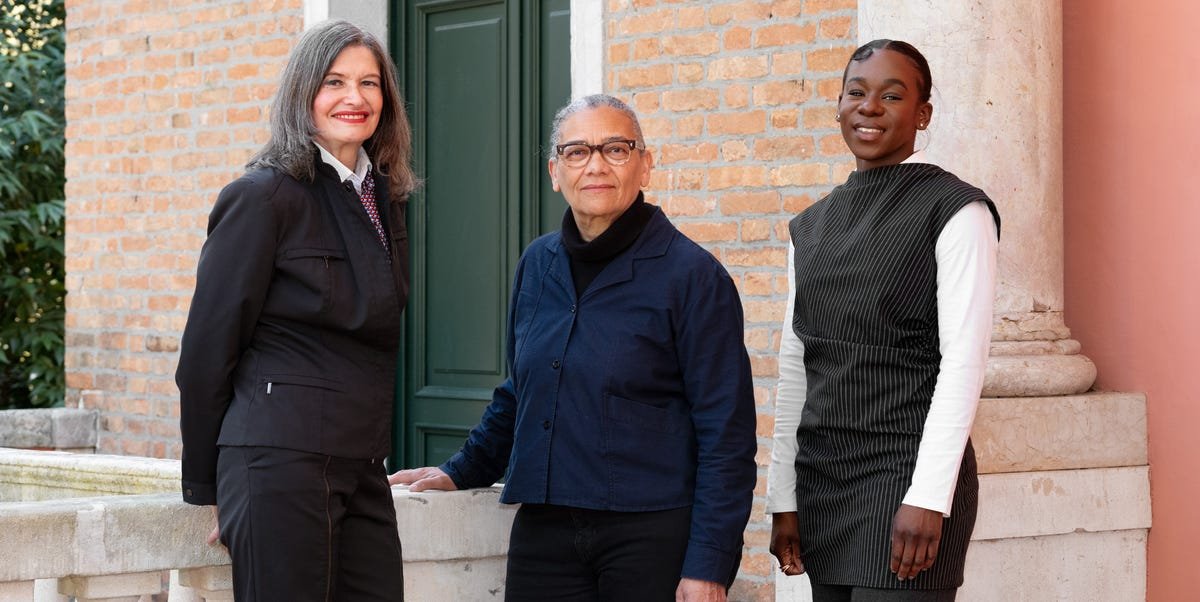
The curator Ese Onojeruo at the British Pavilion
Last July, Ese Onojeruo was appointed the Shane Akeroyd associate curator for the pavilion, and she has been working with Himid and her team in bringing the work to the fore. “She’s set the bar really high for working with an artist,” says Onojeruo of her experience with Himid, who is a stickler for a deadline. For Onojeruo, it was, what she calls “a full circle moment”. As a student of Fine Art at Lancaster University, she was subject to a limited conventional syllabus. “There was a massive gap regarding people’s understanding of specific identities and how they relate within the world,” she says. “I never learnt about Ingrid Pollard, I never learnt about the Black Art Movement, I didn’t know who Sonia Boyce and Lubaina Himid were.”
When she moved back to London, she began forming reading groups who met regularly, uncovering the work of artists and curators who had been left out of the canon of art history, and began to see parallels with what she was doing and Himid’s activities in the Eighties, shining a light on marginalised narratives. “I realised it was a cyclical situation of absence and forgetting. Lubaina was always advocating for the work of artists of colour to be written about so they don’t become forgotten.”

Tailors (2025), Lubaina Himid in the British Pavilion
Following roles at South London Gallery and Chisenhale, Onojeruo became an assistant curator at Tate in 2020. “After having these reading groups, it became important for me to work in the arts – especially as I’ve always worked in publicly funded institutions, which is meant to be free for everyone, and everyone should have access to art,” she says. As part of Himid’s show at Tate in 2021, Onojeruo developed a one-year programme of events with youth and local organisations in response. She has since gone on to work with Anthea Hamilton and to produce films with Evan Ifekoya.
Now, having worked closely with Himid and her team for the Biennale, she acknowledges the effect they have had on her own practice. “It’s been an incredible experience to work with an artist who is so generous with their time,” she says. “A lot of Lubaina’s work is about questions: questioning the space you’re in. It’s important for the viewer to be within the work, to sit within it as opposes to passively looking.

Can Poison Taste Delicious (2025) next to Chefs (2025), Lubaina Himid at the British Pavilion
“There’s so much power in asking questions: is this structure I’m in? Is this building right for me? What does it mean to be part of this empire? What does it mean to migrate? Also… who are we thinking about when we talk about issues of migration, because at some point in some time, we all move. If it’s not from one continent to another, it could be from one city to another, perhaps to find better work. We all have those experiences, and those are really shared universal experiences.”

Gardeners (2025), Lubaina Himid at the British Pavilion
For Onojeruo, she returns time and again to the idea of ‘flourishing’, that from this space of questioning, these figures in each painting are creating beautiful results. “You may take one approach or you may take the wrong approach, and in some cases, it does actually end up being brilliant. So, actually, taking some form of action and doing that collaboratively – you never know where it’s going to take you.” The show at the British Pavilion is certainly testament to that conviction.
Lubaina Himid’s British Council Commission ‘Predicting History: Testing Translation’ for the British Pavilion at La Biennale di Venezia will run from 9 May – 22 November 2026.
[ad_2]
Source link