[ad_1]
Later this month, Toronto-based auction house Waddington‘s is set to stage their Major Spring Sale on May 28, 2026, to coincide with its 176th anniversary. The event’s three sessions include Canadian & International Fine Art at 5 p.m. EST, followed by First Nations Art at 6 p.m. EST and Inuit Art at 7 p.m. EST.
Transcending medium and spanning a diverse range of periods and makers, the three-session sale includes best-in-class examples of numerous collecting categories. Below, we dive into a select few of the sale’s highlights from across sessions.
Lawren Stewart Harris, Lake Superior Sketch, VI (ca. 1925–1928)

Lawren Stewart Harris, Lake Superior Sketch, VI (ca. 1925–1928). Est. $700,000–$800,000 CAD. Courtesy of Waddington’s.
Lawren Stewart Harris (1885–1970) garnered significant acclaim for his landscapes, of which Lake Superior Sketch, VI (ca. 1925–1928) is a premier example. The Canadian artist and Group of Seven co-founder developed a unique style that was compositionally pared down yet psychologically complex—here, the deep, shadowy hues and painterly brushstrokes convey the threat of a storm without compromising the serenity of the Canadian landscape. Dated from a period of prodigious experimentation, largely inspired by the shifting natural world, Lake Superior was one of the artist’s most potent and longstanding sources of inspiration.
David Brown Milne, Heavy Forms (1913)

David Brown Milne, Heavy Forms (1913). Est. $80,000–$120,000. Courtesy of Waddington’s.
Canadian artist David Brown Milne (1882–1953) is recognized as one of the preeminent artists of his generation in Canada, and the year before his passing his work was included in the Canadian pavilion of the Venice Biennale alongside that of Emily Carr, Goodridge Roberts, and Alfred Pellan. While his career overlapping with that of the Group of Seven, and he likewise focused predominantly on landscapes, his work has a decidedly more Modernist sensibility influenced by prevailing trends in the United States and Europe. Painted the same year he was featured in the seminal Armory Show, Heavy Forms (1913) carries on the tradition of the preceding generation like that of Matisse or Cézanne, but nevertheless reveals his inimitable style, including a restricted palette and simplified compositional approach.
Rudolf Ernst, Finishing Touches (n.d.)

Rudolf Ernst, Finishing Touches (n.d.). Est. $100,000–$150,000 CAD. Courtesy of Waddington’s.
A key figure from the orientalist tradition, Austro-French artist Rudolf Ernst (1854–1932) is best known for his works depicting scenes from the Islamic world, such as mosque interiors, and other vignettes inspired by North Africa—both his own travels there as well as from photos and prints. In Finishing Touches (n.d.), a bride is seen in extravagant and luxurious garb surrounded by Moorish architecture. Sumptuous and opulent, his works leverage the perspective of then-new photography to create compositions that are veritable jewel boxes of discovery for the viewer’s eye.
Emily Carr, Somewhere (ca. 1942)

Emily Carr, Somewhere (ca. 1942). Est. $350,000–$450,000. Courtesy of Waddington’s.
Celebrated Canadian artist Emily Carr (1871–1945) is credited with helping shape the Canadian national identity through her renderings of the country’s rugged natural landscapes—particularly those of the West Coast and Vancouver Island. Though not an official member of the Group of Seven, following her inclusion in the 1927 group exhibition at the National Gallery of Canada alongside group members and Indigenous artists, she was closely associated. Somewhere (ca. 1942) underscores Carr’s later preoccupation with movement, with gestural brushstrokes and visual change taking precedence over direct representation.
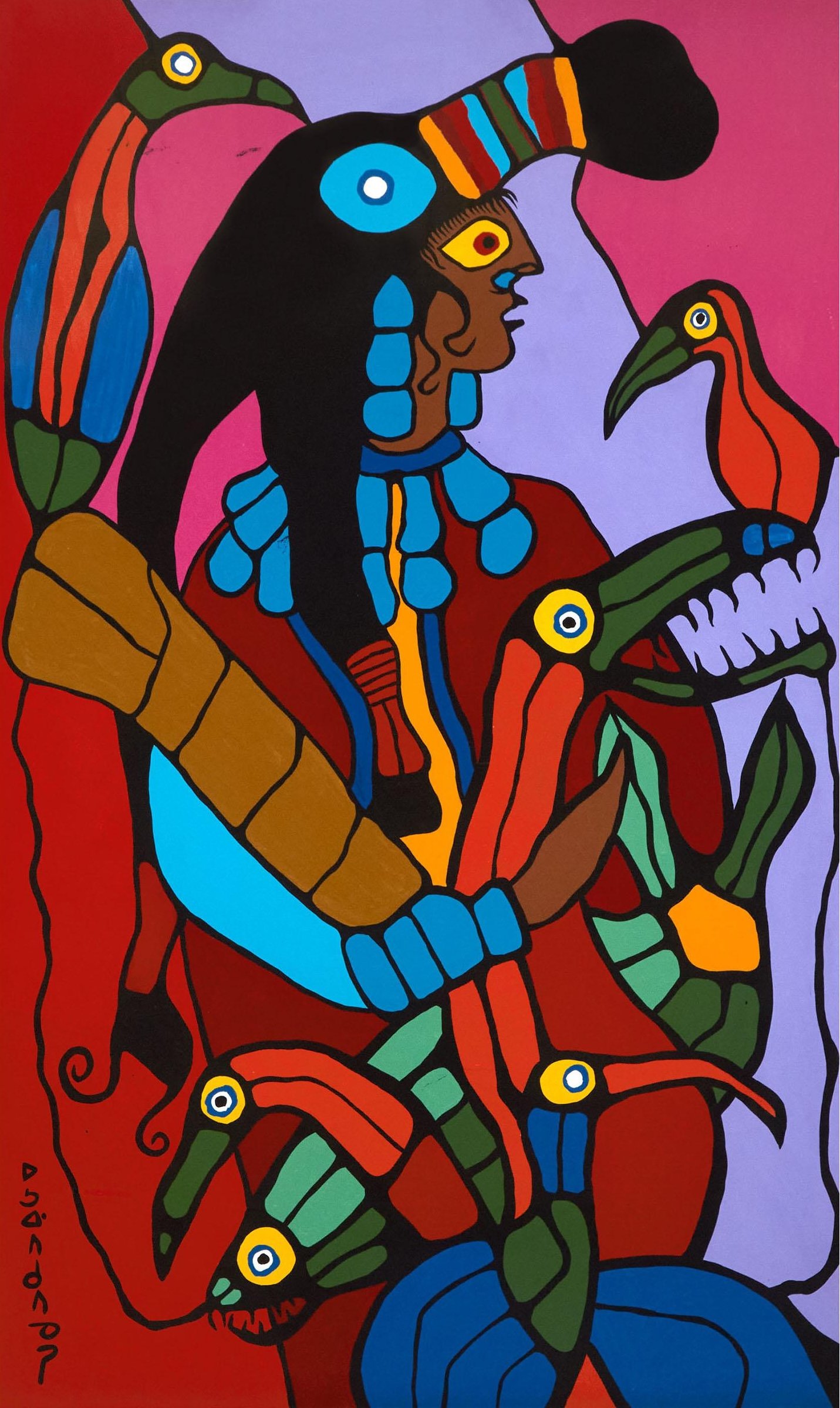
Norval Morrisseau, Young Shaman with Powers (1978)

Norval Morrisseau, Young Shaman with Powers (1978). Est. $100,000–$150,000 CAD. Courtesy of Waddington’s.
Brimming with vivid hues, graphic line work, and symbolic resonance, Young Shaman with Powers (1978) is exemplary of the practice of First Nations artist Norval Morrisseau (1932–2007). Featured in the First Nations Art session, the present work is one of three featuring shamans by the artist in the sale, highlighting his ongoing interest in the subject and motif. The present painting was created at one of the artist’s career highpoints, on the heels of making one of his most iconic works, the six-panel Man Changing into Thunderbird (1977), it showcases the artists practice at the height of his powers.
Karoo Ashevak ᑲᔪ ᐊᓴᕙ, Drum Dancer (ca. 1973)

Karoo Ashevak ᑲᔪ ᐊᓴᕙ, Drum Dancer (ca. 1973). Est. $50,000–$70,000. Courtesy of Waddington’s.
Despite his incredibly short career, lasting only five years, Karoo Ashevak (1940–1974) developed a singular and influential style and practice noted for his use of local traditional sculpting materials (lie time-cured whalebone) and techniques but imaginative, interpretative compositions. Inspired by dreams, spirituality, and shamanism, Drum Dancer (ca. 1973) epitomizes Ashevak’s penchant for dynamic, energetic forms that offer a glimpse into his own personality and creative outlook.
Waddington’s Major Spring Sale series will be held May 28, 2026.
[ad_2]
Source link