[ad_1]
The Metropolitan Museum of Art has officially unveiled the theme for the highly anticipated 2026 Met Gala: Costume Art. The concept delves into the deep relationship between fashion and fine art, offering a fascinating exploration of fashion as an art form.
The Costume Art exhibition will explore how clothing and the human form have been represented in Western art, from antiquity to the present day. At its core, the exhibition examines the dressed body in Western art, juxtaposing garments with artworks across various periods to reveal the dialogue between fashion and visual culture.
Now, though the theme is for the exhibition, some designers have been working on incorporating art into their designs for a long time. Either through surrealism, storytelling or their personal touches, they go all out in terms of couture to showcase something which seems otherworldly. Here are five designers who we think deserve this spot.
Schiaparelli and surrealism
The house of Schiaparelli is probably the first that comes to mind when talking about art as costume. Since the beginning, Elsa revolutionised fashion with the surrealist art movement, challenging conventional notions of taste and beauty. She worked closely with prominent artists like Salvador Dalí and Jean Cocteau to create iconic, witty, and often provocative designs. She was known for using unexpected and everyday items in her designs, such as buttons shaped like teacups, candles, or insects, and incorporating novel materials like cellophane and early plastics.
Even in the latest collections, this has been justified. For instance, Daniel Roseberry sprinkled subtle references all over the Haute Couture fall/winter 2025-26 show, going back to Elsa’s earlier works. The highlight was the corseted satin dress constructed with a fake torso and breasts in the back, with a pulsating red rhinestone heart necklace hanging just below the nape.
Iris van Herpen and natural art
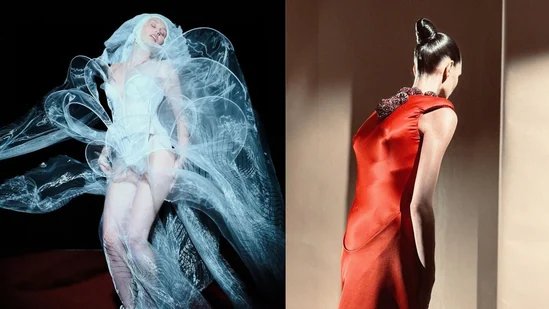
Rooted deeply in nature motifs and elements, Iris van Herpen has made a name for themself in the world of art. Art in its most raw form takes inspiration from nature, and for ages, poets, artists and painters have been basing their work on it. This is true for Iris van Herpen, whose creations are frequently regarded and exhibited as fine art sculptures due to their innovative designs and unique materials (3D-printed elements, organics, bio-materials).
Her work feels more like wearable research or speculative biology than mass-market fashion. For one of her latest works, she created a gown that incorporates 125 million bioluminescent algae (Pyrocystis lunula). The dress glows in response to movement and changes in the environment, symbolising a symbiotic relationship between fashion and ecology.
Thom Browne and theatre
Thom Browne is the beacon of theatrical art. His designs feature suits and tailoring turned into tableaux and performance, often layering formal codes with absurdist scale. It also includes intricate storytelling, performance art and very elaborate set designs. Each show unfolds like a narrative, with a distinct story or theme, often exploring philosophical questions or social commentary. For example, his Fall/Winter 2025 collection presented a story of lovebirds longing for freedom, set in an enchanting aviary.
He also uses theatrics to challenge traditional ideas of fashion and gender roles. He often plays with proportions, incorporates elements of classic menswear into avant-garde silhouettes (e.g., skirts and kilts for men), and blurs the lines between clothing, costume, and art.
Alexander McQueen and historical art
It is no surprise that Alexander McQueen would make the cut for this category. His form of artistic expression was heavily influenced by various art forms, historical periods, and artists, which he channelled through dramatic and theatrical fashion shows. He considered himself an artist whose medium was fashion.
For one of their latest work (Spring/Summer 2024–2025), they showcased anatomical and historical motifs (roses, Elizabethan references, sculptural tailoring) that translate into costume-like tableaux on the runway.
For the 10th anniversary of the iconic skull scarf, McQueen collaborated with the contemporary artist Damien Hirst, who created 30 limited-edition designs featuring kaleidoscopic insect and butterfly patterns that formed the skull motif.
Jean Paul Gaultier and artistry
Jean Paul Gaultier’s work is profoundly intertwined with the art world through museum exhibitions, collaborations with renowned contemporary artists and photographers, and a design philosophy that elevates fashion to an art form itself. Gaultier’s costume designs for films have also been significant artistic contributions, showcasing his creativity beyond the runway. His cinematic collaborations include: The Fifth Element (1997) by Luc Besson, Kika (1993) and Bad Education (2004) by Pedro Almodóvar, The Cook, The Thief, His Wife and Her Lover (1989) by Peter Greenaway and The City of Lost Children (1995) by Marc Caro and Jean-Pierre Jeunet.
Duran Lantink’s Jean Paul Gaultier debut made a bold statement with futuristic pneumatic silhouettes straight out of a sci-fi fever dream this year. But the real attention went to the NSFW hairy bodysuits featuring fully naked male bodies in lifelike detail, including a realistic phallus. The internet buzzed, calling it less of a runway show and more of an anatomy lesson.
[ad_2]
Source link