
[ad_1]
88
Sylvain Castet has spent his life building at the intersection of art, culture, and design. He was 20 when he opened his first design studio in Bordeaux, working across branding, digital products, packaging, campaigns, and print. But early on, it became clear that his ambition would never be confined to one medium. Every category he entered — retail, hospitality, music, branding — became a laboratory for the same obsession: how do you make culture tangible?
“I have never been interested in building something empty. Whatever the medium was, I wanted it to have a pulse, a point of view, and a reason to exist.”
That obsession refused to stay in one lane. Before he was 30, Castet had opened a nightclub, built a beverage distribution business, and launched a specialized beer cellar with over 2,000 references—one of the largest selections in France at the time. Each venture was different in form and identical in intent: find a space where culture wasn’t being taken seriously, and take it seriously.
It was in retail, though, that his vision first took its most distinctive form.
In Bordeaux, Castet opened one of the first concept stores in France, Culture of Rock, entirely dedicated to rock culture. The space was more than retail—it was a cultural hub. Visitors could browse curated books, discover niche clothing brands and footwear, dig through music albums, and experience live showcases, all anchored by a central bar that turned the store into a living, breathing venue, open from 9am till 2am without interruption, breaking every code of traditional retail. Think of it as a Colette-like concept, but entirely devoted to the spirit, aesthetic, and energy of rock.
The store was among the first in France to introduce brands like King Kerosene, La Marca Del Diablo, Lucky 13, and Paul Frank to a new generation of consumers. But perhaps its most unlikely achievement was Converse. At the time, the brand was widely considered dead—a relic with no cultural currency. Culture of Rock brought it back into the conversation, helping reignite a following that would eventually make Converse one of the most recognizable sneaker brands in the world.
The space also pioneered something that had no precedent in French retail at the time: live concerts and showcases hosted inside the store. Over the course of its run, Culture of Rock hosted more than 400 showcases. Every ticket sold went directly to the performing band. Zero commission. The decision was deliberate—Culture of Rock wasn’t interested in monetizing the music. It wanted to be a genuine vector of revenue for independent and emerging artists who had talent but no platform. Promoting culture, in Castet’s view, meant making sure the people creating it could actually survive from it.
“It wasn’t about selling products. It was about creating a space where culture could exist in real time. Where people didn’t just consume it—they lived it.”

(Courtesy)
That same ability extended into brand work. Castet played a key role in the relaunch and creative direction of major global beverage brands amongst the Pernod Ricard group, helping reposition them with sharper identities. But the story that best captures his instinct for cultural timing predates all of them: he was among the first to push Red Bull into the French market during its regulatory gray zone, when the drink was outright banned. He moved anyway. It was the same impulse that would define everything that followed: identify what people don’t yet know they want, and find a way to put it in front of them.
About fifteen years ago, Castet moved from France to San Francisco without speaking English—not to follow a role, but to challenge himself in a faster, more demanding environment. In 2012, he opened Le Bordeaux, an authentic French restaurant in San Francisco inspired by his roots.
The place got attention. People came. It felt real. Then it collapsed. His liquor license application was denied. Then he lost the restaurant. Half a million dollars disappeared with it.
“That was the kind of loss that strips everything back to the bones. You find out very quickly whether you are attached to a single venture or to the act of building itself. You also find out that in certain neighborhoods, the real obstacles have nothing to do with the quality of what you build—they are political, territorial, and entirely indifferent to merit. I never followed the crowd. I never bent to pressure. That comes at a cost sometimes. But at least I stay loyal to my principles.”
He rebuilt. In 2014, Castet joined IDEO, the legendary design and innovation firm whose human-centered methodology had shaped some of the most influential products and experiences of the modern era. It was there that his instinct for cultural empathy found its most rigorous professional framework. From IDEO, he moved to Telenav, where he today serves as Vice President of UX and Design, leading global design efforts for digital experiences used by millions of drivers worldwide.
Music had always been part of Castet’s creative life. At 18 he was producing his own tracks, writing professionally for BMI under JIVE Records, and would go on to release his own album, Parler2nous, under Pegasus Records, and co-produce soundtracks for two Bay Area television shows—Dinner pour deux and What SF. That immersion gave him a firsthand understanding of where the music industry fails the people who make it run.
Also in 2012—running parallel to Le Bordeaux, because Castet has never done one thing at a time—he founded SOUNDEALER, a music collective designed to bridge the gap between elite “hired gun” musicians—professionals touring with artists like Justin Timberlake, Prince, and Pink—and commercial storytelling, enabling them to license their original compositions rather than remain invisible behind someone else’s stage.
“Those musicians were shaping the sound of global artists. But they had their own voices. SOUNDEALER was about giving those voices a platform in a different context.”
Across all these ventures—retail, branding, music, hospitality, and design—the common thread remained unchanged. Castet was never building for the sake of category. He was building for impact.
“I have always been wired for aesthetics. The emotional charge of an object, the way a space feels, the way a visual lands—that’s what drives everything.”
That long arc of experimentation and creation ultimately led to Arttitude, the California-based artwear brand he co-founded with his wife, Amrita. The premise is sharp and uncompromising: art belongs on you.
The partnership is not incidental. Where Sylvain operates from pure creative instinct—image, emotion, cultural tension—Amrita brings the strategic and analytical counterweight: market positioning, brand architecture, the disciplined thinking that transforms a creative vision into a scalable proposition. Together they form a single, unified output. The work is neither purely artistic nor purely commercial. It is both, fully, at the same time. Because creative vision without execution is just intention—and execution without vision is just noise. The distance between the two is where most brands get lost. It is where Sylvain and Amrita excel.
Not framed at a distance. Not confined to institutions. Worn. Lived. Carried into the world.
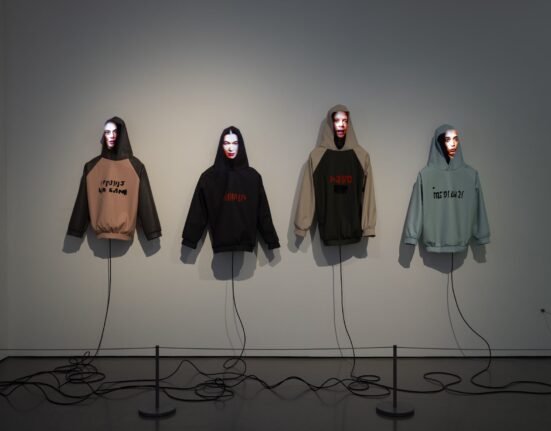
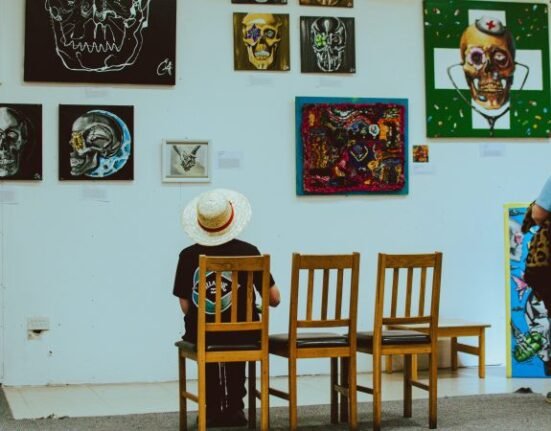
Each Arttitude collection draws from fine art, visual philosophy, and cultural tension—from Caravaggio to memento mori to the Seven Deadly Sins—and is released in strictly limited, numbered runs. No restocks. No repetition. Take the Memento Mori Skull Heavyweight hoodie: a hand-adapted rendering of classical vanitas iconography translated onto a premium garment, numbered, traceable, and gone the moment it sells. It is not merchandise. It is a wearable artifact.
Then there is IED—currently Arttitude’s best-selling collection, and perhaps its most culturally charged. The premise is deceptively simple: a middle finger. But the narrative behind it runs deep. The gesture is one of the oldest in human history, dating back over 2,500 years to Ancient Greece, where it was used to represent a phallus—a deliberate instrument of insult, threat, and dominance. From Greek philosophers to Roman emperors, its meaning has remained consistent across millennia: contempt, rendered physical.
What Arttitude does with that history is where it gets interesting. Every image in the IED collection portrays women—exclusively. Women reclaiming a gesture that was designed, historically, to assert male power. The collection is built around a single, unambiguous idea: that empowerment sometimes looks like a raised finger, and that it is entirely okay not to be okay. In a political moment that offers little to celebrate, IED resonates because it says, without apology, exactly what a lot of people are feeling but haven’t found the words for.
“Sometimes a middle finger is the fastest way to convey the mood of the day.”
That willingness to meet people exactly where they are—emotionally, politically, culturally—is what separates Arttitude from labels that treat art as decoration. The provocation is never empty. It is always rooted in something older and deeper than the garment itself.
Fine art, in his view, has been kept at a psychological and economic distance for too long. Clothing offers a more democratic canvas. It enters the day with you. It turns philosophy into presence.
“Art should be alive. It should interrupt a Tuesday afternoon. It should start a conversation in the street. It should do more than sit in a room waiting to be respected.”
That belief shapes the details. Arttitude embeds coordinates of original artworks into garments, quietly nudging wearers toward the source. The brand is committed to limited runs, traceable materials, and artist-signed authenticity cards that position each piece as a numbered collectible. Every sold-out drop stays sold out. That matters because Castet is building against the logic of fashion that says make more, scale faster, and flatten the object into inventory.
“Scarcity for us is not a trick. It’s a philosophy. If something has meaning, it shouldn’t be diluted.”
He also wants the brand to widen access, not just sell exclusivity. Castet talks about building programs for young creators who do not have the institutional access that often determines who gets seen, funded, or taken seriously. That ambition makes sense coming from someone who has started over more than once and built across disciplines that rarely speak to one another cleanly. “Reinvention is a skill,” he says. “If you can learn to rebuild without losing your center, you can carry that into anything.”
The brand has already stepped onto the global stage with a presence at New York Fashion Week, proving that an independent label can operate on its own terms. But the ambition runs deeper than visibility.
Castet is not interested in creating another streetwear label. He is defining a new category: luxury artwear. The vision owes something to Virgil Abloh, whose ability to collapse the distance between fine art, fashion, and street culture Castet had long admired. The two were scheduled to have lunch together. Abloh passed away two days before they could meet. The loss was personal in the way that losses are when you recognize someone as a genuine peer—someone building toward the same idea from a different direction.
In Abloh’s absence, Castet sees only one creative mind operating at that same intersection of fashion, music, and cultural category-creation: Ye. And if you ask him, a collaboration would not just be welcome—it would make perfect sense.
Picasso is widely regarded as a misogynist. Gauguin was involved in the sexual abuse of minors. Dalí expressed admiration for authoritarian leaders including Hitler and Franco, a position that saw him expelled from the Surrealist movement. Francis Bacon was described by those close to him as a sadistic ogre. The list does not end there. And yet the work endures—studied, celebrated, and institutionalized. Not because history absolved the men, but because it learned to hold both truths at once.

(Courtesy)
“You have to be able to isolate the art from the artist. Because great art almost always comes from tormented, complex personalities. That has been true for centuries. It doesn’t get more comfortable just because we have social media now.”
That argument is not separate from what Arttitude is building—it is the foundation of it. A brand willing to engage with the full complexity of art history, including its darkest corners, is one that takes art seriously enough to let it be uncomfortable.
“We’re not putting art on clothes. We’re turning garments into cultural objects.”
That perspective is rooted in decades of cross-industry work. From cultural retail spaces to music platforms to global brand relaunches, Castet has studied how people engage with experiences—and where most industries fall short. “They optimize for function or sales,” he says. “They forget the human being in front of the object.”
Arttitude flips that equation. It treats clothing as a living medium—one that can carry philosophy, provoke thought, and create connection in everyday life. Each piece is numbered. Materials are carefully sourced. Authenticity is treated as a core value, not a marketing angle. Once a drop is gone, it stays gone.
“I have no interest in endless duplication. If someone is going to wear a conviction, it has to carry weight.”
That conviction extends to the canvas itself. Clothing, in Castet’s view, is the most democratic medium art has ever had—not because it is cheap or easy, but because it moves through the world in a way a gallery wall never can.
“Clothing is the most democratic canvas we have. It moves. It lives. It reaches places traditional art never will.”
From pioneering cultural retail spaces in France to building creative platforms in the U.S., Sylvain Castet has spent decades operating ahead of categories—and absorbing the cost of doing so.
With Arttitude, he’s not just building a brand. He’s redefining where art belongs next.
Discover Arttitude: www.arttitude.us
Follow Sylvain Castet on Instagram: @iamsylvaincastet
In partnership with APG
[ad_2]
Source link