[ad_1]
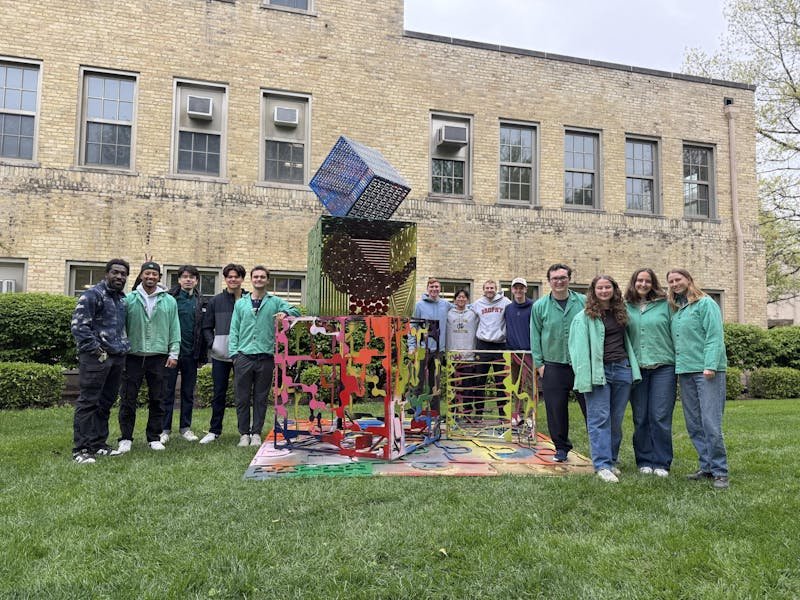
Francis Akosah‘s metal sculpture class has recently displayed sculptures outside of Riley Hall of Art and Design. Two of the three sculptures were made by the students, while the other was created by Akosah as a demonstration of the techniques.
Akosah explained he deviated from the traditional route of having students make small pieces, which they then get to take home. Instead, this semester, he opted for large pieces for public display.
He explained that this semester‘s class was broken up into four units: an introduction to the tools and equipment, learning how it works through demonstration, exploring what the broader community and industry are doing and finally having students make their own.
Senior Madelyn Cerney explained that for the large project, they were divided into three groups, with each group assigned to one of the figures and one of the boxes.
Senior Madeline Schearer explained it was interesting within groups because they divided up the statues into smaller parts, but then it was “sort of a struggle” to get all of the pieces to fit into one another and then all of the figures into the one larger statue.
“When we went to put them together, the legs fell apart and it was very frustrating because we spent like weeks on it, and then it all fell apart, and we had to start kind of over again,” Schearer said, noting this came toward the end while they were doing a big push to get it finished. However, she said, “the biggest win was when we saw it together, and it was like, ‘oh this actually worked.’”
Cerney added, “We did not really anticipate how much it would have to be moved around. The welds, while strong if you were just playing it down flat on the table, were not really holding when you were trying to put it up.”
The product this class ended up with was different from what they had initially envisioned.
“Our original inspiration: We were going to stack the statues on top of the cubes, and probably it would have been like 17 feet tall, which was very ambitious of us,” Schearer said.
Cerney added, “We had to scale that back just a little bit.”
“We started out with a plan, and it did not go to plan,” senior Bjorn Mauritsen said. “What happened was that to get a mold in order to make those figures was going to be really expensive, so we had to pivot, find something cheaper. This is where we came up with two separate sculptures.”
Cerney explained that they already had the necessary styrofoam figures, so they were able to plaster these and use them as a mold to share the pieces.
As a part of this project, they took a field trip to a steel warehouse.
“I think going to the steel warehouse was really informative and really kind of guided our decision-making process, because we were able to use scraps from all the pieces they are cutting out on the daily,” Cerney said. “It was kind of like, ‘How can we use these pieces that we have available to us and repurpose them and give them some life?’”
The third statue, which is of a figure with wings, was created by Akosah after the students had questions about the process and how it was all going to come together. When it came time to display it, he decided “to make it more aesthetic. Just add some butterfly wings,” which were crafted from off-cuts.
“Although she is standing alone, we don‘t want her to look sad, so at least put some fairy wings on it,” Akosah said.
Cerney explained that she thought the biggest win was the installation.
“It was so much fun. We were all out on the quad, enjoying what we had created and figuring out exactly how we wanted things to look, so that was really special,” she said. Cerney noted that Akosah had moved the works outside that morning.
Akosah explained the department owns a forklift, pallet jack and gantry for moving heavy objects like these outdoor sculptures.
Once outside, they gave “Constructing Thoughts” some finished touches of spray paint and drilled holes in the base to avoid water collection. For “Unity in Motion,” they selected the exact positioning and drilling into the metal so they could bolt the figures to the base.
The bolts were going from the dome into the metal base because while they hope in the future a cement pad might be laid down, for now, “Unity in Motion” is anchored to a metal plate. Schearer noted they “broke quite a few drill bits,” while doing this task, but Cerney added they “got it done without having to go buy more.”
The exact weights of the sculptures are unknown, since they did not have access to the type of scale needed for this kind of measurement, but Schearer, Cerney and Akosah all expressed that it was very heavy.
Information and opinions about how long these sculptures will remain in their current location are mixed.
Cerney said, “We have been told that there is no end date insight, so we will see what ends up happening, especially with future classes, if they are also making these larger pieces. Obviously, we can‘t house them all, so I think it kind of just depends on the future classes and the future of Riley Hall.”
Mauritsen said, “I would be surprised if they are here next fall, frankly, but I am not part of the decision-making process for how long they stay out here.”
Akosah explained that for this project, he spoke to Austin Collins, an art professor responsible for the sculpture department and vice president of Mission Engagement and Church Affairs in the office of the president, who agreed to have it near Riley.
Akosah hopes that this shift toward making public art could spark conversations that lead to being given various locations to make art for and have it displayed at.
Collins explained the sculptures will be there through the end of the semester — maybe through graduation.
Akosah said that given the nature of the class, there was a 12-person limit on the number of students he could accept. He calls these students his 12 disciples.
Mauritsen noted that he took metal sculpture and metal foundry to fulfill his fine arts requirement. While he only needed one of the courses, he got into metal sculpture later in the registration process and never dropped foundry.
Discussing the class, he said, “It was a blast. As a political science major, like most majors at Notre Dame, you do not have that many opportunities to be creative. That was something I really missed from high school and before high school, and I got it back this semester.”
Mauritsen said he recommended everyone fulfill their art requirement outside of Riley “not just learning about art in the classroom,” so that students can be creative in a hands-on sense.
[ad_2]
Source link