[ad_1]
There’s a detail worth noting in the press materials for Japan House London’s debut photography exhibition. The show, which opens on June 03, was originally titled Invisible [インヴィジブル].
It was later renamed Kyotographie: Kawada Kikuji x Iwane Ai, presumably for clarity. But something was lost in the retitling: the original gets closer to what both photographers are actually doing. Neither is really interested in what’s in front of the lens; both are focused on what isn’t.
While both Japanese, Kawada Kikuji (born 1933) and Iwane Ai (1975) are separated by 42 years and work in almost entirely different registers. They’ve never exhibited together before, but put them together and a single question runs through everything on the walls:
What does a camera reveal that the naked eye (or collective memory or grief) refuses to see?
If you’ve ever made a picture that surprised you with what it contained, that question will feel familiar. And both of these artists have spent careers trying to answer it.
The two artists
Kawada came to prominence in the 1960s when he co-founded the Vivo collective, a group that collectively rewired what Japanese photography could do. His series Chizu (The Map, 1965), shown here alongside later work including Los Caprichos (1968–1981) and the Last Cosmology, is widely considered Japan’s most significant photobook.
Look at The Map and you’ll see what looks like abstract art: stained, scarred, almost painterly surfaces. In fact, you’re looking at the residue of postwar Hiroshima, made physical through wild darkroom experimentation.


Kawada worked partly from contact sheets, found paper and detritus. The resulting images don’t document history so much as make it tactile. This isn’t photography as record-keeping; it’s closer to something like archaeology.
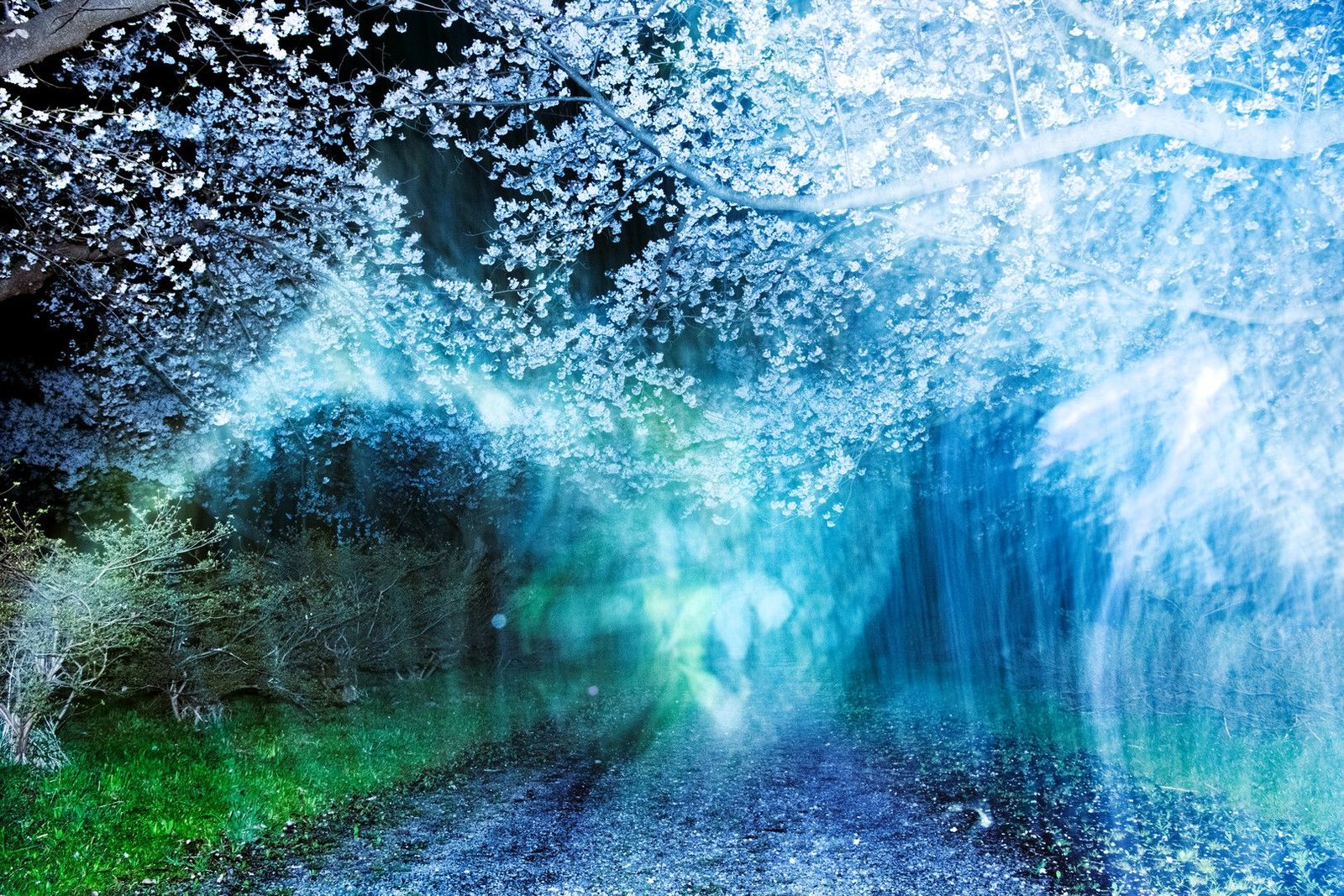
Iwane is just as technically ambitious, but at the opposite end of the emotional spectrum. Her photographic series A New River (2020), shot at night in the Tōhoku region during COVID, is the kind of work that makes you want to know exactly how it was made.
Working in complete darkness among cherry blossom trees, she shoots figures dressed as supernatural folkloric characters: shamanic priests, white-shrouded forms, creatures from Japanese folk tradition.
The exposures are long enough that the figures blur into the landscape, half-present and half-absorbed by the dark. The resulting images fuse together grief, hope and the consolation of ritual inside a single frame.


Her earlier series, Kipuka (2018), seems different at first: panoramic, communal, warmly documentary in its depiction of Japanese immigrant communities in Hawaii.
But showing it alongside A New River enables us to see the similarities between the two. Both series explore transience, identity carried across generations and a sense of belonging maintained by ceremony.
A UK debut
The show is directed by the folks behind Kyotographie International Photography Festival, one of Asia’s biggest photography events. Founded in 2013 by Lucille Reyboz and Nakanishi Yūsuke, this Kyoto festival drew nearly 300,000 visitors last year. This is their first UK project.
It’s also a first for Japan House London, on Kensington High Street, which has never staged a photography show before. The run extends to October 18 and, if you’re able to get to London, it’s well worth a visit.
Kyotographie: Kawada Kikuji x Iwane Ai is at Japan House London, 101–111 Kensington High Street, London W8 5SA, from June 03 to October 18 2026.
You might also like…
See what’s on: current and upcoming photography exhibitions.
[ad_2]
Source link