[ad_1]
By Curtis Bunn
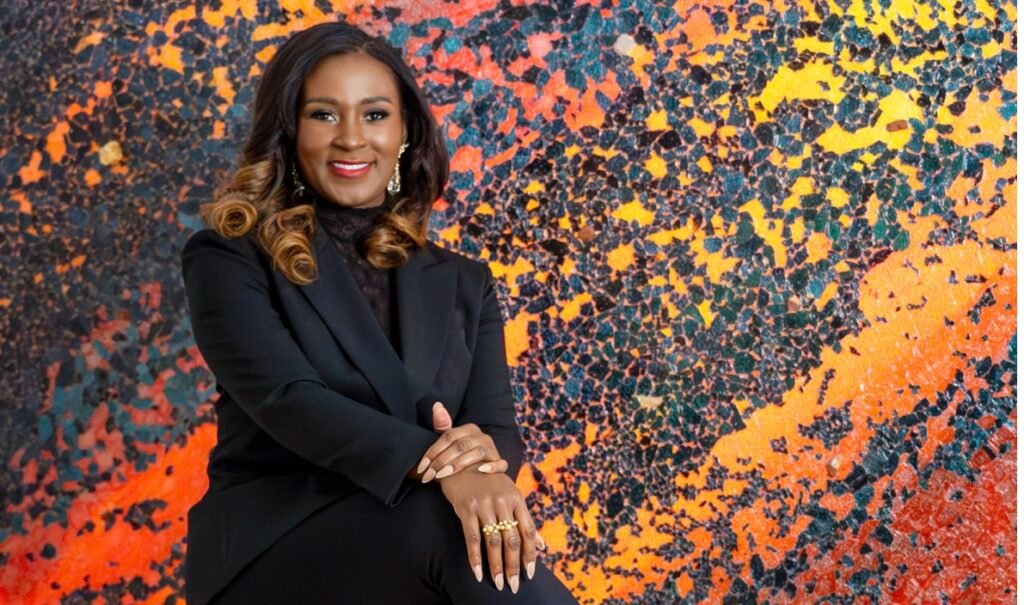
As a young girl growing up in Atlanta, Charlotte Newman was exposed to the transformative power of art through her parents and godmother, the renowned painter and mixed-media artist Tina Dunkley.
That passion stayed with her as she earned a degree in Art History at Wellesley College, an MBA at Harvard, and a working career that spanned multiple roles in the House of Representatives and U.S. Senate, entrepreneurship, and serving as a global technology company executive.
Now, Newman, 43, has parlayed her educational and professional experiences with her passion to emerge in a $59.6 billion industry as one of the foremost collectors of fine art by Black artists and talent from the diaspora.
And while she has spent plenty on historic, original, and commissioned pieces, she said a commitment to expanding access to Black fine art to working-class Black people ranks at the forefront of her ambition.
“To me, art exists on a continuum; it is culture,” Newman said. “We put fine art on a pedestal, but I think that is almost to its detriment. We begin engaging art not through acquisition, but through seeing.”
Like her other endeavors, Newman finds herself a unicorn of sorts: a Black woman in a fine art industry dominated by white men, who represent 87% of collectors compared to 4% of Black collectors, according to a study conducted by the Public Library of Science. Also, only 2.2% of acquisitions by 31 U.S. museums between 2008 and 2020 were works by Black artists.
There is an important distinction between art and fine art. Art encompasses numerous practices and techniques. Fine art is visual art created primarily for aesthetic, intellectual, or emotional value rather than functional, commercial, or decorative use.
Newman sees fine art as a “way to create and transfer wealth. But it also transfers something less quantifiable: culture, memory, taste, and a way of seeing the world. That’s why I think collecting can be both an economic act and a legacy-building practice.”
To that end, she founded the Scott Newman Collection to support artists of African descent, continuing a family tradition that focuses on arts appreciation and stewardship. The collection embraces figurative and abstract work that draws on literary narratives, science, and mythology. Her artists explore politics, race, gender, and sexuality.
“It is intended to be a vehicle for legacy,” she said, “a way to preserve cultural value, contribute to generational wealth and steward the work of artists we believe should endure.”

Screenshot
Newman said she has not sold any of the more than 50 works of paintings, photographs, works on paper, and mixed media. Her collection, she said, is “rooted in a specific thesis: that the market has historically undervalued work by artists of the African diaspora and that intentional capital can serve as a corrective instrument.”
But fine art, in general, is pricey, leaving many in the working-class Black community feeling priced out. Newman said the initial step of increasing access is vital to growing exposure to the industry.
“It’s not just about affordability,” she said. “It is also about information, proximity and confidence. The art world can feel closed because people do not always know where to begin, what questions to ask, or whether to trust their own perspective.”
Newman, however, believes access to audiences who feel left out is evolving through online viewing rooms, which began during COVID, fine art fairs, and the Clubhouse app—convenient ways to learn basic art history and gain an appreciation for the work. Also, Newman provides insight into the art world through her Substack column, Crown and Capital.
“It’s absolutely essential to have Black collectors and patrons be continuous stewards and support both living and historical Black artists,” said Lindsay Adams, a Washington, D.C.-area artist based in Chicago. Newman purchased Adams’ piece, The Source of Self Regard, named after Toni Morrison’s book of essays. “It helps to further ground our cultural legacy and voice. . . and the role that we play in the art historical canon.”
A prized piece in the Scott Newman Collection includes an 1880s work by the celebrated Edward Mitchell Bannister, who, in 1876, became the first Black artist to win a national art award—a bronze medal for his painting “Under The Oaks” at the Philadelphia Centennial Exposition.
She also had a “full circle” moment in 2025 when she won a Gordon Parks photograph at auction during the foundation gala named after the famed photographer, filmmaker, and writer who documented social injustice and the civil rights movement. When working on Capitol Hill, Newman helped write the Congressional Resolution commemorating Gordon’s life and legacy.

In 2019, artist Alteronce Gumby of New York said Newman “slid into my DMs” on Instagram to inquire about his work. “We had a great conversation about art, my background, her background, and language around color and its relationship to astrophysics and astronomy,” Gumby added. “We shared some of the same cultural signifiers. I can get really deep into my interests and the ideas that matter to my work, and Charlotte truly seemed willing to go along for the ride.”
That ride continues with Newman serving as an executive producer on Gumby’s upcoming film, “Color In Nature,” a documentary that explores color as an elemental force, tracing it through climate, chemistry, and light across environments spanning Icelandic glaciers to Nigerian dye post pits.
This type of beyond-the-art connection is a part of Newman’s process. She seeks to unite with the talent—and then support the art and the artist. “I’m very often intrigued by what they are reading and how they are pulling ideas and literature together,” she said. “And that’s not the whole list.”
There are not many art collectors with Newman’s heterogeneous background. The influence of Dunkley, who preserved and developed the art collection at Clark Atlanta University, is palpable. “Charlotte tells me about these details that she remembers from her youth about conversations she heard about art between me and her parents and others, and it’s amazing,” Dunkley said. “She’s a shooting star with great sensitivity.”
Said Newman: “My godmother helped shape how I see art. Through her eyes and her practice, I learned how to appreciate art, how to live with it and how to understand its value.”

With that vantage point, she sacrificed and saved money post-college and began collecting. Her degrees from two of America’s most renowned universities helped Newman earn high-profile and high-income careers with a perspective of “the world in terms of gains and losses, assets and liabilities,” she said. “But they have also helped me understand that value is not only financial. Culture, relationships, reputation, access, trust, and ownership are all part of value.”
She’s a financial whiz who worked on Capitol Hill advising New Jersey Sen. Corey Booker, among other politicians, on economic policy. She also led Amazon’s multibillion-dollar international entrepreneurship division.
Newman, who lives in Washington, D.C., said her home looks like a gallery, with artwork adorning much of her wall space. She also learned in college how to exhibit art to magnify its beauty.
The most recent piece she purchased was “Wade In The Water” by Candice Tavares, a young talent based in Baltimore. “It’s really quite gorgeous,” she said. “I was drawn to the way she combines stained glass and woodcut techniques. There’s an intricacy to the work that makes it feel both delicate and deeply constructed.”
Tavares said support from a Black woman collector “gave her extra confidence. It’s really important to have my work live in spaces with people who value the story behind the work.”
That value increases over time, like art.
“The industry is underwhelmingly Black,” Gumby said, “which is why this kind of presence matters so much. It shows how important and special Charlotte’s role is. Knowing my work is in the collections owned by Black women and Black collectors more broadly signals that my work is being cared for by my community.”
RELATED CONTENT: A ‘Little’ Art Show Opens With A Big Bang At Atlanta’s Zucot Gallery
[ad_2]
Source link