
[ad_1]
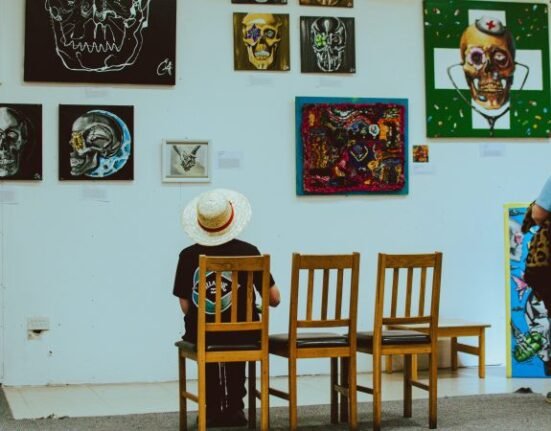
An ongoing exhibition in downtown Plattsburgh invites artists and visitors to explore the intersection of creative expression and mental health.
“Holding Space: A Community Exhibition on Art and Mental Health” will be on display at the Strand Center for the Arts through May 30 for Mental Health Awareness Month. It’s a collaboration between the Strand and Behavioral Health Services North (BHSN), a mental health nonprofit.
Barb Guay oversees a recovery program at BHSN and runs a creative expression therapy group there. Several of the people she works with submitted art for the exhibition.
“We had somebody that put art in that has some formal training in art. We have people who really do and create art for relaxation and then somebody put some stuff in as part of their sobriety recovery,” she said. “I think for each of them it connects to their values and just their recovery stories.”
Guay has her own artwork on display, too. She told Champlain Valley reporter Cara Chapman about the self-care plan she painted using watercolors. Their conversation has been lightly edited for clarity.

BARB GUAY: It’s really hard for me sometimes to write things out, and so I wanted to create something that reminded me of what’s important for me to be well. If I’m going to show up in this space and if I’m going to help people in their recovery, I really have to honor my own recovery. So I created this self-care plan that includes some of my creative expression. It also includes a version of myself as a rehabilitation practitioner, which is my dream job. I love what I do every day. It also gave people insight, I think, into how I take care of myself and keep showing up in this space.
CARA CHAPMAN: Can we talk a little bit more about the details? There are different panels that you incorporated into this piece, like “Pink Power Suit Barbara,” “My Own Best Friend,” and “Fruitbat Barbara.” Can we talk a bit more about those?
GUAY: I think we all have different parts of our identity. “Pink Power Suit Barbara” is really about empowering myself in learning and education. One of my biggest values is just to learn. There are some little details on there, like a laptop and a little image of work, some books.
“My Own Best Friend Barbara” really explores my experience with endometriosis and living with chronic illness and the ways I care for myself. My cats are on there. They’re a big part of my self-care. Water and drinking enough water. Having a to-do list, so keeping myself organized. There’s just a carrot on there because I think fresh foods are a really big part of caring for myself, having a chronic illness.

“Fruit Bat Barbara,” that’s really about my artistic side. I had created my own Halloween costume a few years back, where I’d hot-glued some wings and a bunch of dried fruit on a dress and went out and about in the community with it just to share that little bit of joy with folks. There’s a painting I did for my great-grandmother, who was an artist and had inspired me at a very young age to get into art.
The last one is my most recent painting, and that’s “Rehabilitation Practitioner Barb,” and that has a brain. It also has my recovery date. I’ve been in recovery from using opiates and coke since August of 2015, so I have quite a few years in recovery. It also has a DSM-R on there because that’s a big, important part of being a mental health counselor and doing intakes with folks. I get to help people explore diagnoses and what those things can mean, and maybe even not mean for us. People are a lot more than what we label them as.
CHAPMAN: You’ve been in recovery for more than a decade now. What has your art meant for you during that time?
GUAY: My art has carried me through a lot of really tough times. Prior to my recovery, if I lost someone or something didn’t go my way, I would turn to substances. If I didn’t feel good about myself, I would turn to substances. And that’s how I learned to cope for a really long time. My art has been such a healthy outlet for my grief, for my depression, and for, I think, just the really heavy moments. I think one of the things that it’s allowed me to do is hold space for people differently. I think that we can shame ourselves for the ways that we’ve shown up in the world, or we can honor those experiences and use them to help somebody else in their recovery journey.

CHAPMAN: Why is it important to have an exhibition like this one in public, where people can talk about what they’re going through and see how it manifests in art for other people? Why is an exhibition like “Holding Space” important?
GUAY: I think it’s important for a handful of reasons. One, it helps decrease the stigma and shame that people experience when living with mental illness or struggling with substance use. For our community, I think it reminds people that there are safe spaces for them to show up. Also, it allows them to tell their story. It’s such a powerful platform to be able to show up and share your art and to connect with people and to feel validated. I think that when folks walk into this space, and they see art that looks and feels like their depression or looks and feels like their struggles with PTSD or whatever it is that they’re carrying with them, it’s just a really validating and, I would say, probably a really moving experience. We’re a community, and if there aren’t spaces like this for people, then I think it’s easy to get isolated. I think it’s important to have a space that allows for connection and to be seen and heard as our authentic selves, and just to keep creating.

[ad_2]
Source link