
From May 23 to Sept. 20, 2026, the Royal Museum of Fine Arts Antwerp (KMSKA) is hosting a major exhibition dedicated to British sculptor Antony Gormley, featuring more than 100 works.
The Royal Museum of Fine Arts Antwerp (KMSKA) welcomes Antony Gormley. Geestgrond, which aims to be the largest exhibition ever held in continental Europe dedicated to the celebrated British sculptor Antony Gormley (London, 1950). Curated by Carolyn Christov-Bakargiev, the exhibition is the result of a close collaboration between artist and curator, establishing a direct dialogue with the museum’s important collection and expanding to urban spaces leading toward the Scheldt River. On view from May 23 to Sept. 20, 2026, Geestgrond brings together more than one hundred of Gormley’s works, made from materials as diverse as clay, stone, wood, glass, bread, iron, lead, and steel. The exhibition documents the constant evolution of his artistic research, ranging from traditional casting techniques to experimental processes based on digital scans, used to investigate the human body.
The exhibition aims to highlight Gormley’s fundamental contribution to contemporary sculpture and reflection on the human presence in the world, developed over more than forty-five years. His works explore the relationship between body, space, and knowledge, emphasizing how human experience is profoundly linked to physical presence in places and ethical relationship with others and the more-than-human environment around us.
Gormley first presented his work internationally in 1980, during the Milan Triennale. His early research, developed in the late 1970s and early 1980s, was strongly influenced by Arte Povera and other art movements of the 1960s and 1970s. From that movement he inherits an interest in matter, alchemical transformation and the perception of space through the body, which is considered an integral part of the work itself.
Within KMSKA, Gormley’s sculptures are placed in relation to works from the museum’s historical collection: from a 14th-century Flemish Crucifixion to the paintings Grey Seascape (1880) and Man of Sorrows (1891) by Belgian proto-expressionist painter James Ensor. The exhibition also creates comparisons between very different works, such as a medieval polychrome Sedes sapientiae, Auguste Rodin’s Fallen Caryatid, and a modernist welded iron mask by Julio González.
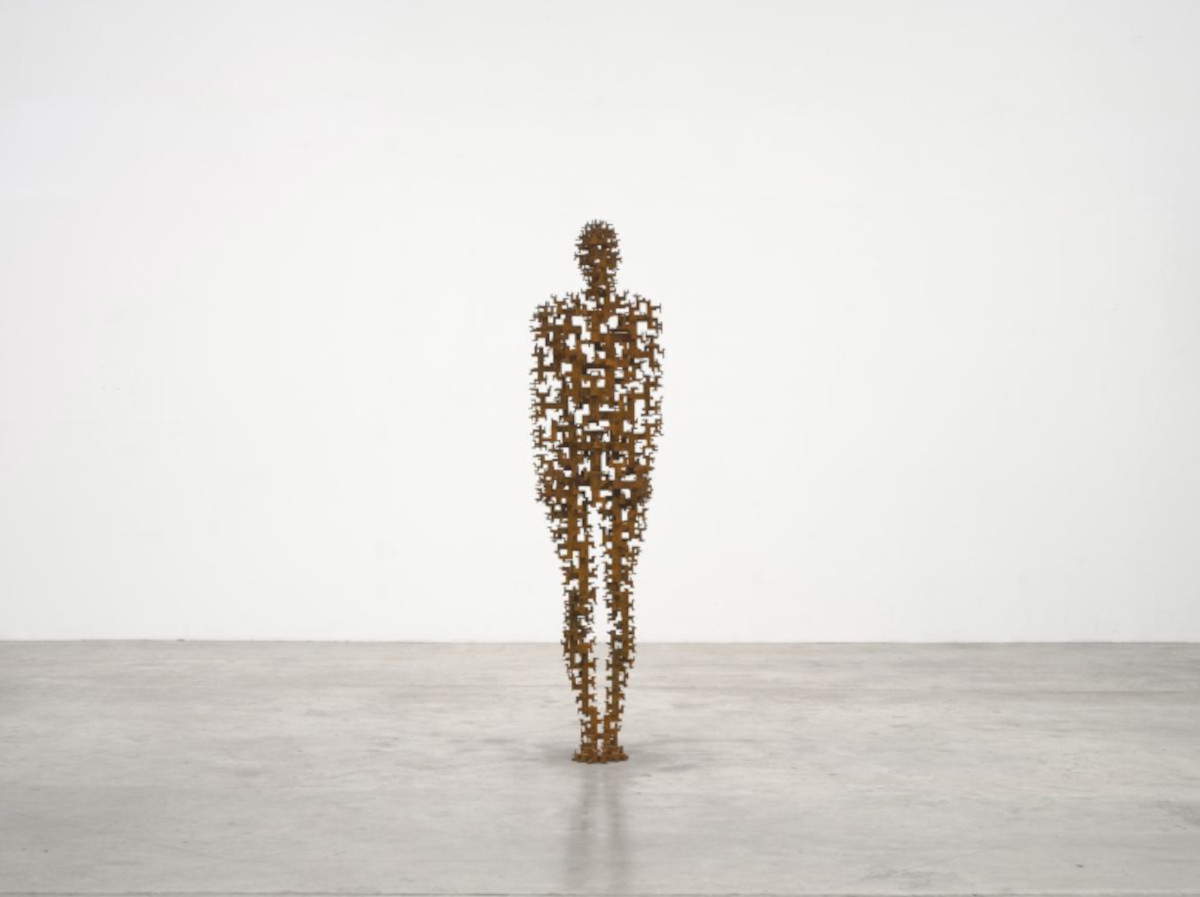
Works from the Weave Works series, including Brace (2023), Subject IV (2022) and Butt (2022), are distributed throughout the museum’s historic rooms as almost ghostly presences, animating spaces beyond the traditional galleries and guiding visitors along a circular route through the building.
Geestgrond aims to transcend the conventional limits of museum space: it neither begins nor ends exclusively in the exhibition rooms, but extends to the streets of Antwerp and the nearby riverbank. The museum thus becomes an open and permeable space, conceived as a place of movement, crossing and resonance. Some sculptures in the Domain series observe the city from the museum’s parapet, others dialogue with Cristina Iglesias’ outdoor fountain or stand along the river.
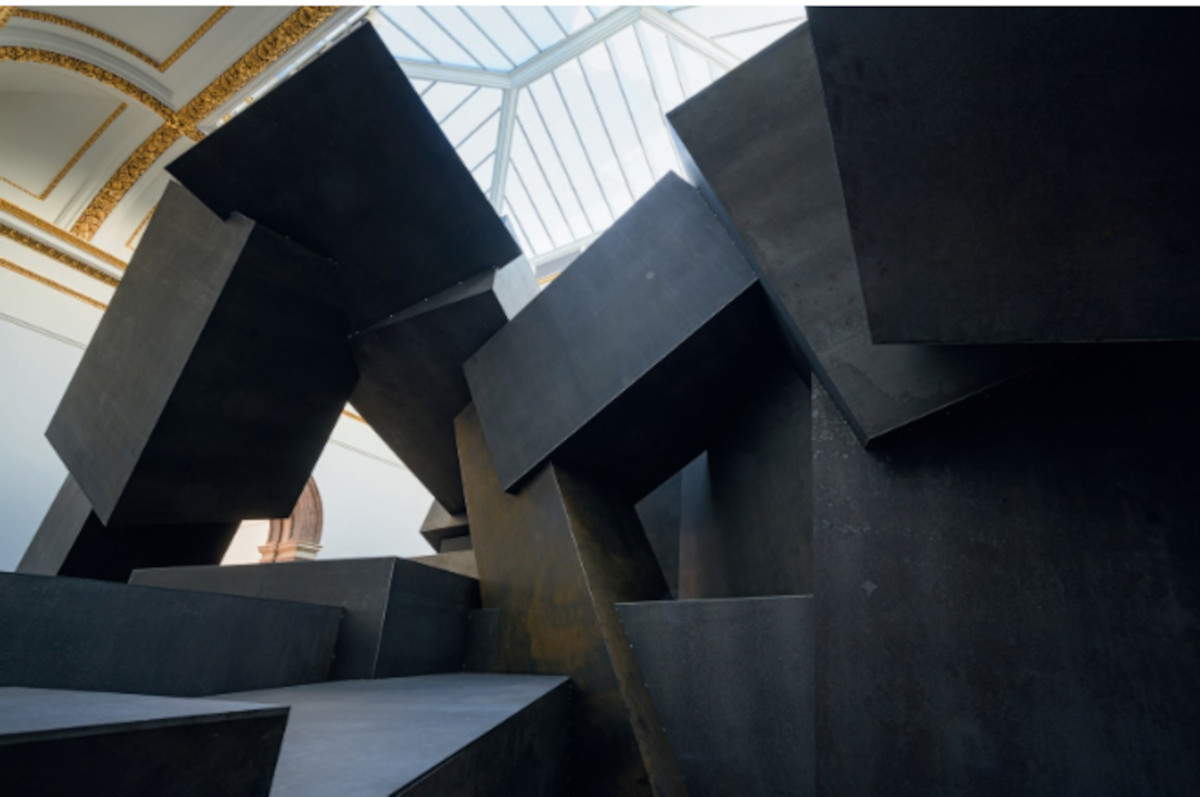
The title Geestgrond refers to a raised terrain shaped by the glacial movements of the Ice Age, but its meaning goes beyond the geological realm. In Dutch, geest means spirit or soul, while grond means soil or earth. The combination of these terms creates a deliberately ambiguous word that expresses the tension between spiritual and material dimensions, between mind and weight, between memory and matter. This duality is central to Gormley’s artistic practice. From the earliest lead casts, which affirm the body’s presence through mass and gravity, to the more open and reticular structures of the Domains and Weave Works series, the artist investigates the relationship between body and space without ever losing the connection to the ground. Even the lightest and seemingly dematerialized works maintain a strong physical grounding. In the recent Brancher Attend (2025), presented for the first time in this exhibition, oxidized iron elements restore an image of the body that is again heavy, earthy and deeply connected to matter.
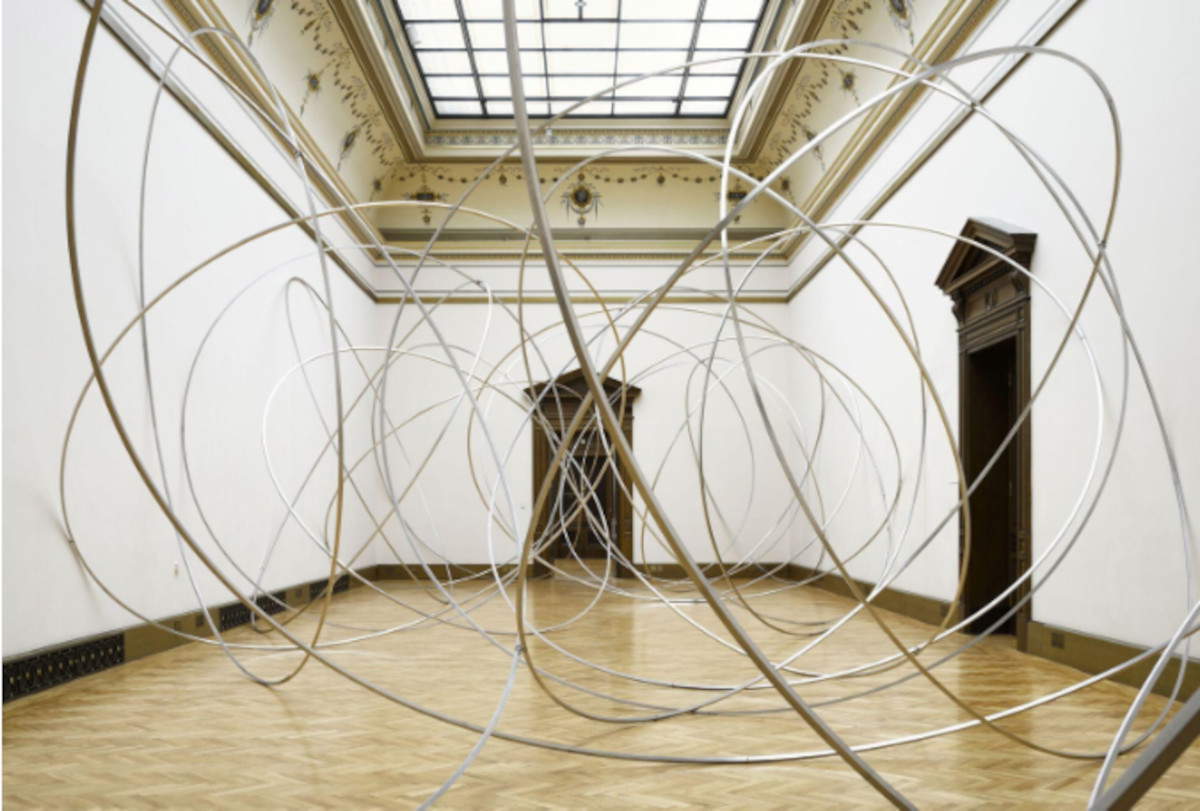
The exhibition is conceived as a circular path activated by the movement of visitors. At the entrance, in the 19th-century atrium, the work Lean (2023) seems to support the museum’s grand staircase. The audience then traverses a space dominated by Rodin’s Fallen Caryatid and Small Stop (Lead) VII (2015), a work by Gormley that materializes the concept of mass and gravity. Next we enter a new version of Orbit Field III (2026), a large installation composed of rings that wrap around the body and invite the visitor to physically enter the work. Passing through the different galleries, the path finally leads to Cave (2019) and back again to Orbit Field III, completing the exhibition cycle.
The heart of the exhibition is The Heart section, conceived as a kind of Wunderkammer. Here notebooks, models, photographs, prints, drawings, annotated books and even notes in the margins of a school copy of John Milton’s Paradise Lost allow us to enter the artist’s creative process. An introspective investigation oriented toward the origins of his artistic thinking. Gormley’s practice develops through a continuous dynamic of relationships and encounters. The works dialogue with each other, reflect each other and testify to their presence through the centuries; at the same time, they seem to observe the viewer, engaging the visitor in a direct and reciprocal relationship.
“The KMSKA provides the ideal setting for this exhibition, enabling a dialogue between contemporary art, Old Masters, architecture, and the newly renovated museum spaces. Gormley is an artist who activates places; his work draws meaning from the context in which it is presented,” explains Carmen Willems, General Director of KMSKA. “Starting with the body, he invites physical and mental interaction: we move through the sculptures and through the space. This aligns perfectly with KMSKA’s DNA as a hybrid museum, where art activates people instead of leaving them as passive spectators.”
“What if sculpture could breathe? What if art did not just stand in front of you, but stood with you, silently changing the way you inhabit space, time and yourself? Come to Geestgrond not to seek answers, but to perceive possibilities. Come to experience and be moved. This exhibition explores the need for art to address the human condition in our age of radical change. What does it mean to be human in the age of AI? Can sculpture help us be more present and more grounded?” reflects curator Carolyn Christov-Bakargiev. “The exhibition also features a section entitled The Heart, a constellation of youthful notebooks, sketches, travel photographs, annotated books and various other materials that create a dynamic dataset of a single human being: that of Gormley himself.”
|
| At the Royal Museum of Fine Arts in Antwerp a major exhibition on Antony Gormley, with more than one hundred works |

Warning: the translation into English of the original Italian article was created using automatic tools.
We undertake to review all articles, but we do not guarantee the total absence of inaccuracies in the translation due to the program. You can
find the original by clicking on the ITA button. If you find any mistake,please contact us.