/file/dailymaverick/wp-content/uploads/2025/10/label-Op-Ed.jpg)
As a result of renewed pressure, there has been intervention – albeit indirectly – from President Cyril Ramaphosa in establishing the Presidential Johannesburg Working Group. One of the focus areas of the group is heritage sites and cultural institutions. There is a specific sub-group within the Arts and Culture Ministry focused on the Johannesburg Art Gallery (JAG).
While this is relatively good news, unfortunately the City’s relocation plan is happening partly outside this process, and there have been complaints from heritage groups of a lack of coordination.
Nel Erasmus, JAG’s director from 1957 to 1977, explains that the original JAG building has always been plagued by issues of structure and space.
“The partly built structure presented an ever-pressing and constant lack of both exhibition and workspace. The space problem continued, and got worse as time passed,” she explained.
The current crisis is a threefold one.
/file/attachments/orphans/LrgJAG2026-CreditFriendsofJAG_670365.jpg "Nel Erasmus, the former JAG director, has highlighted a historical pattern of political interference and space inadequacies that have plagued the gallery since its inception. (Photo: Friends of JAG)")
In a nutshell it involves the physical collapse of the building, which in turn affects artworks – a failure of governance involving the City versus experts and donors, along with poor planning, mistrust and political tension between national and local government.
These failures are part of a bigger and more entrenched pattern where political sway has affected the performance of the institution.
What has become very clear is that JAG’s collections are not regarded as important by some of the players involved. As Erasmus observed decades earlier, the Gallery’s fate has always been tied to whether it operated under a “friendly” or “unfriendly” council.
Decades earlier, similar concerns were already being raised from within the institution.
Erasmus explained that at a certain point in her time as director, “It then became clear to me that the work at JAG would not be about promoting the Art/Collection anymore, but… about personal ambition and politics,” leading her to conclude that “politics and museum matters should be kept separate, as far as possible”.
She believed that “the City Council had direct access and influence on JAG matters, which should never be the case”, and that “a friendly City Council and an unfriendly City Council… can have a far-reaching and long-lasting effect”.
A combination of Erasmus’ increasing workload and burnout, the appointment of a successor and the loss of institutional control to the City Council of the time led to her resignation in 1977.
“The start of the rot” at JAG, as Erasmus refers to it, came after her resignation. There was a breakdown of museum discipline accompanied by the theft of Van der Leer works and an El Greco (cut from its frame).
To appreciate JAG’s importance, it’s vital to recognise what it represents.
Important African cultural resource
JAG is regarded as one of the most important cultural resources on the African continent. It holds one of the largest art collections in Africa, numbering more than 10,000 artworks. Its collections cover approximately 500 years of work, including colonial European works, modern and African contemporary art.
National treasures include Gerard Sekoto, Sydney Kumalo, Walter Battiss, and William Kentridge. International masters like Picasso, Monet, Degas and sculptors such as Rodin and Henry Moore are all part of the collection.
JAG’s pictures and sculptures engage with colonial influences, apartheid struggles, resistance and post-apartheid transformation. For even those with no interest in aesthetics, the artworks found in the collection capture the pulse of South African history by telling a visual story of our past and present.
/file/attachments/orphans/LrgOldphotooftheJohannesburgArtGalleryviatheLutyensTrust_388900.jpg "An old photo of the Johannesburg Art Gallery. (Supplied by the Lutyens Trust)")
To understand the present situation, it is necessary to return to the institution’s origins. The early beginnings of JAG are like a tale, not of two cities, but of two very remarkable women – two very different women, living at different times: one the wife of a mining magnate, the other an abstract artist.
The first woman sacrificed something valuable and personal to support JAG’s existence. The second woman made her mark on JAG with a purchase that showed a rebellious, forward-thinking spirit that helped keep the institution abreast of the art world.
Just over a century ago, philanthropist Florence Phillips, or “Lady B” as she was fondly known, sold a piece of personal jewellery – a diamond ring – to fund artworks, believing that what Johannesburg needed was a “semblance of cultural life”.
“Lady Phillips became keenly aware of the stark contrast between the cultural wealth of Europe’s great capitals and the cultural paucity of Johannesburg. Determined to address this imbalance, she set out to enrich the mining town by establishing an art gallery,” explained Erasmus.
In 1910, JAG, a public art gallery, was established by the Johannesburg Town Council, funded by both public and elite private money but driven and shaped by its founding patron, Lady B.
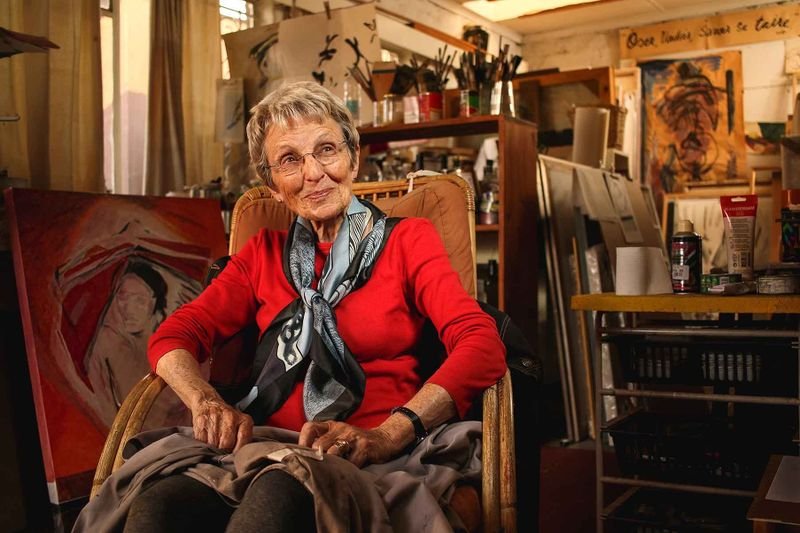
/file/attachments/orphans/LrgNelalonewithherworks2023PhotoCredit_ArnolddeBeer_264210.jpg "Nel Erasmus alone with her works 2023. (Photo: Arnold de Beer)")
Forty-seven years later, Nel Erasmus, the well-known abstract painter, joined JAG, first as a professional officer. Later she became the director until her retirement in 1977.
Her approach to curation and leadership was shaped not only by her role at JAG, but by her development as an artist. Born in 1928 in Bethal, Transvaal province, Erasmus was one of SA’s earliest abstract artists.
Her leadership is perhaps best illustrated through her acquisition strategy. In 1973, Erasmus bought a Picasso, Tête d’Arlequin, via Friends of JAG, which was formally set up in 1976.
“Friends of JAG were extremely interested in the purchases of various collections. They handled the funding of the Picasso back in 1973,” she said. This purchase was deeply strategic and would become a watershed moment in her leadership at JAG. Erasmus said that the purchase, was met with public outcry; it was criticised for being elitist and irrelevant to then apartheid SA.
Concerning the purchase, Erasmus relates how “the famous artist Vladimir Tretchikoff said in a front-page newspaper article… ‘I’ll eat her opinion for breakfast.’”
Erasmus’ forward thinking in making this purchase was later acknowledged. However, this period was also marked by uncomfortable and deep political and social contradictions. JAG was presented as a public gallery, yet access was restricted by race. While it promoted avant-garde modern art, it was caught in the oppression of an apartheid system.
“We were all used to an open-door policy… Unfortunately, this friendly atmosphere changed towards the late 1960s,” she said. One night, a black visitor was refused entry to a chamber music concert held at JAG.
Another incident involved a staff member, Orlando, who was assaulted by the police and suffered a broken rib and severe injuries when he was taken to prison. The court outcome favoured Orlando.
These tensions also played out in practical decisions for the institution. Erasmus writes of another time-bound ugly incident: “I formed part of a committee that selected a talented artist for a prize that would improve their exposure, not only locally but also internationally. As a committee we settled on Louis Maqhubela, a pioneer of abstract art at the time, and black,” she explained.
Later there was a personal attack regarding the committee’s choice of work. A councillor named Oberholtzer stormed into another meeting that Erasmus was attending, and confronted and threatened her.
/file/attachments/orphans/LrgNelErasmusJAG1970s-SuppliedFriendsofJAG_275268.jpg "Nel Erasmus at work at JAG in the 1970s. (Photo: Supplied by Friends of JAG)")
In 2023, The Nel Erasmus Art Legacy Trust, a South African public benefit organisation, was launched along with a retrospective exhibition of her work.
What happened during Nel’s directorship is happening again with JAG: a repeat of tension with the City Council – space and infrastructure issues then, and structural collapse now.
In spite of its many challenges, the Johannesburg Art Gallery remains one of the most important cultural institutions in SA and on the African continent. It has weathered more than a century of political, social and structural upheaval – a nod to its tenacity and importance.
On a positive note, the current crisis has also revived public interest, brought together artists, historians and supporters who are concerned about JAG’s future. This renewed concern continues to inspire efforts to preserve the collection.
Erasmus says: “The Johannesburg Art Gallery has weathered many storms before – there is every reason to believe it can do so again.”
This moment has every possibility of being a turning point, where past mistakes are addressed and rectified. With all parties unified under the same vision and inspirational leadership, the gallery has a chance of once again becoming a leading institution for art, education and public engagement.
Finally, the story of JAG should be viewed as one of endurance, potential recovery and more importantly the vital importance of art in society. DM