
When using artificial intelligence platforms, errors and misunderstandings are habitual and expected; every misconstrued image prompt or malfunctioning chatbot reinforces the fundamental imperfections of such technologies. The artist Peter Macdonald invites us to linger on these mistakes, harnessing AI’s awkwardness to assess the way we interpret art and the world around us in an increasingly automated society.

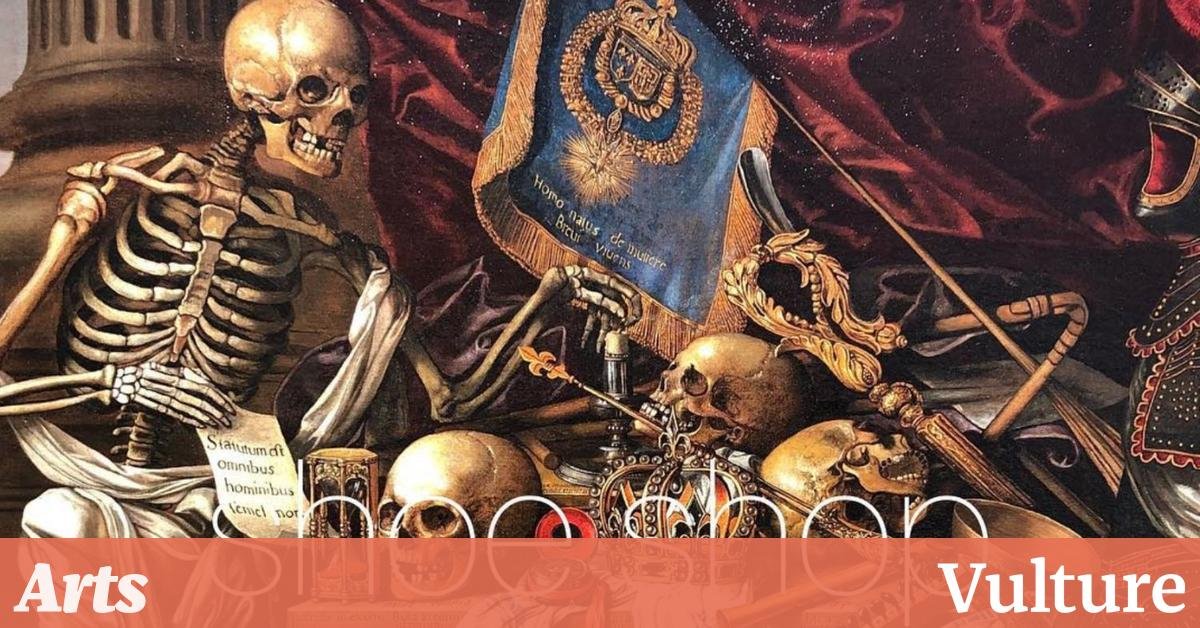
In a series of works completed in 2019, Macdonald employs early iterations of AI to create pieces that combine famous artworks with overlays of their perceived textual image classifications. The result is a surreal dialogue between what is seen, and what AI thinks it sees. In one example, Jeff Koons’ stainless-steel bust of Louis XIV – an opulent tribute to baroque grandeur – is boldly stamped with the automated caption ‘hair slide’. The regal metallic curls and polished surfaces, designed to echo aristocratic vanity, are instead reduced to a mundane everyday accessory. Similarly, the complex mortality expressed in a still life by Luyckx, sensitively depicting skulls, wilting flowers and extinguished candles, is rendered by AI as a ‘shoe shop’. The absurdity of these missteps invites a reevaluation of what is required to recognise meaning in an image; data or pattern recognition offers a poor substitute to the nuance of perception instilled by the breadth of human memory, experience and instinct.
“The regal metallic curls and polished surfaces, designed to echo aristocratic vanity, are instead reduced to a mundane everyday accessory”
This individuality of human perception is crucial to the broader debate regarding the role of AI in art, where the proliferation of image-generation technologies is believed to be a potential threat to the value and necessity for artistic production. Paradoxically, Macdonald’s AI-based works present a strong contradiction to such concerns. Despite the centrality of AI software in the inception of these works, they fundamentally would not exist without the deliberate gesture of Macdonald. He chooses the mistakes and delights in them, reminding us that meaning in art does not result from unbiased accuracy, but from the partial, the personal and the intensely individual. If the captions precisely described their pictures, reading ‘bust of Louis XIV’ or ‘Vanitas still life’, the images would hold little weight. The human gesture is the essential mediator between coded technology and a tangible, thought-provoking work of art; the artist’s role is not erased but redefined, breathing life into otherwise impersonal data.
“It is a deliberately futile attempt at impersonating AI, interrupting the simple trajectory of input and output with the authentic unpredictability of the artist and material”
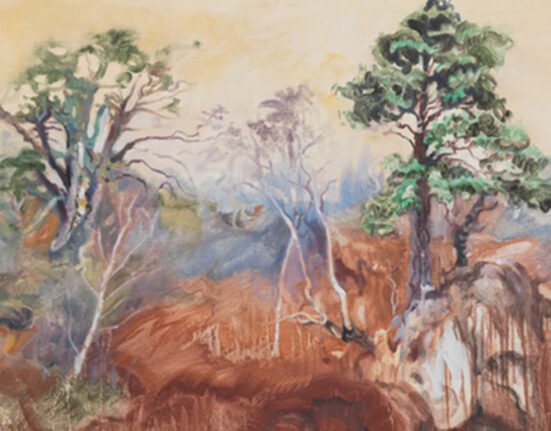
Macdonald’s recent practice pushes this idea further – as AI grows increasingly accurate, and the mistakes that provided such fruitful vessels for examining ways of seeing decrease, Macdonald instead assumes the role of AI himself. He sets himself a prompt akin to that of an image generator, and endeavours to instinctively paint his own response. He focusses not on the accurate emulation of a subject, but on the abstract materiality of paint on canvas – loose, tactile, imperfect. The physicality of the brushstroke, the drag across canvas, the layering of paint, fundamentally foregrounds the human hand. It is a deliberately futile attempt at impersonating AI, interrupting the simple trajectory of input and output with the authentic unpredictability of the artist and material.
AI can endeavour to imitate, categorise, approximate; but it cannot gesture, hesitate or doubt. It cannot mislabel Louis XIV as a ‘hair slide’ with a deliberate irony or create a piece of art solely based on instinct and gesture. Through these works, Macdonald ultimately argues that art does not need to compete with AI, but can thrive beside and beyond it.