A version of this article originally appeared in The Back Room, our lively recap funneling only the week’s must-know art industry intel into a nimble read you’ll actually enjoy. Artnet News Pro members get exclusive access—subscribe now to receive the newsletter in your inbox every Friday.
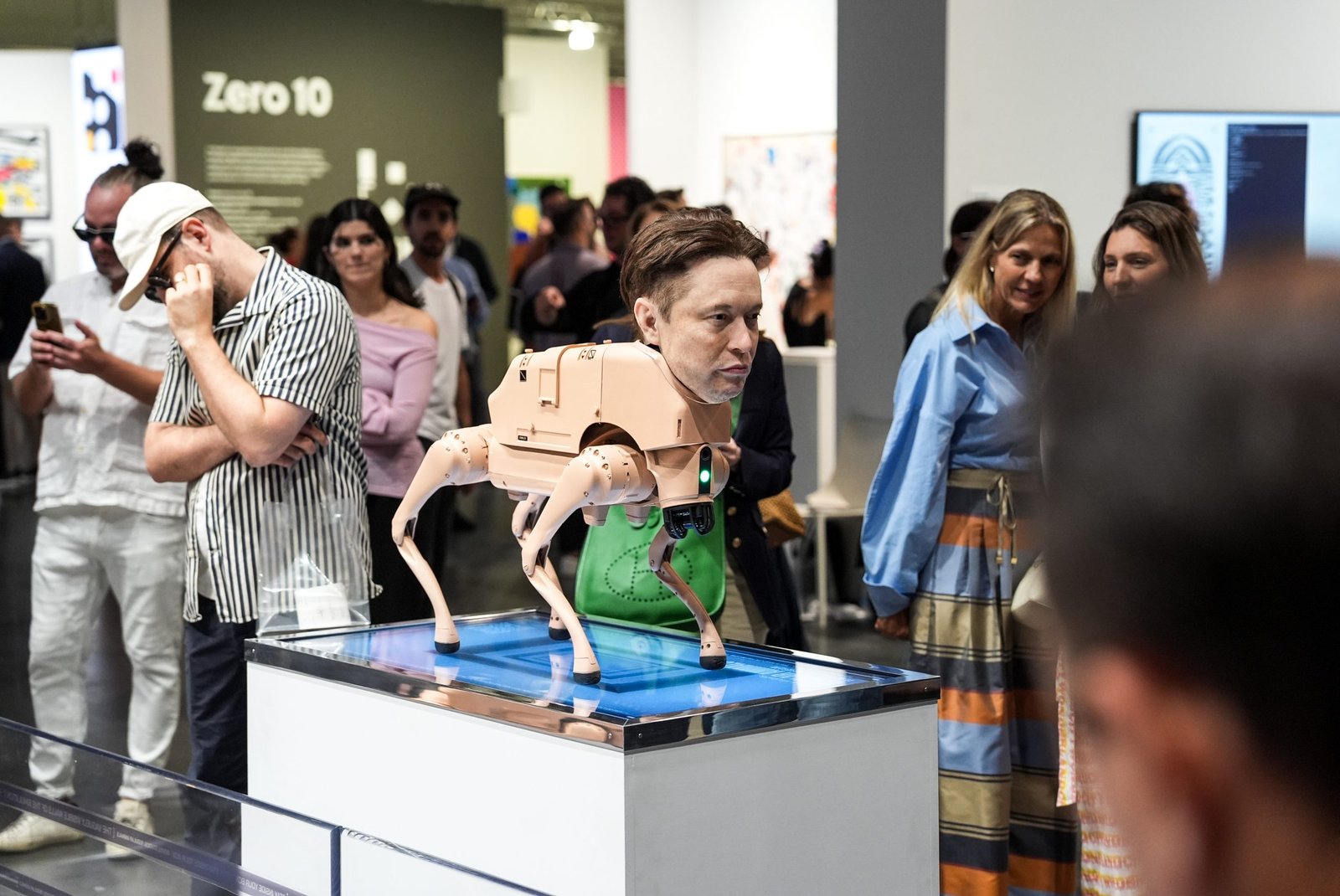
Even if you weren’t at Art Basel Miami Beach this week, it’s likely that your social media feed was still swarmed by Beeple’s Regular Animals: cursèd robo-dogs featuring hyper-realistic heads of some of the world’s biggest billionaires. (The frenetic hair that jerked back and forth with each mechanical step of the four-legged Elon Musk lookalike will haunt me for months.)
The nightmarishly uncanny machine mutts were exactly the kind of spectacle that Art Basel needed to ground its new section for digital art, which had very few screens, surprising some. According to Art Basel CEO Noah Horowitz, one aim of Zero 10, as it’s called, is to attract would-be art buyers from the tech sector—an ongoing, but so-far unrealized, goal for the trade. Remember Pace’s Palo Alto space? And Christie’s digital art department? RIP.
Has Art Basel cracked the code?
Conversion Complications
The industry had a chance to lure in the tech crowd during the NFT boom of 2021–22, but that didn’t pan out, in part because there was too much emphasis placed on “converting” new buyers to traditional art. As my colleague Katya Kazakina wrote earlier this year: “Now that the bubble has burst, the speculators are out of the picture, off flipping meme coins, where no one makes them feel inadequate or insists that they buy three things they don’t want to get the one thing they do.”
Humbled by three years of contraction, the art market may finally be willing to play ball with digital-first artists and collectors on their terms.
“There’s a sense that digital-native artists aren’t ‘crossing over,’ it’s actually the art world that’s slowly shifting toward them,” said Leyla Fakhr of SOLOS Gallery, which is presenting the work of the generative artist, coder, and painter Tyler Hobbs at ABMB. She added that, during the pandemic, everything was hype-driven; now people are engaging more with the actual ideas and processes behind the work.

Visitors view work by Tyler Hobbs at SOLOS gallery’s booth at Art Basel Miami Beach 2025. Courtesy of Art Basel.
Buyers now want to “understand generative authorship, web-native practices, how these artists think about labor, identity, and systems,” Fakhr said. “There’s still a lot for the traditional market to absorb, but everyone knows the cycle is shifting. Digital isn’t a trend—it’s the cultural baseline.”
Institutional Acceptance
Art Basel is not the first established fair to dedicate a section to tech-based practices. Paris Photo, for one, launched a successful digital sector three years ago. But a marquee event like Basel putting digital art front and center is “a significant shift toward integration,” said Micol Apruzzese of Fellowship. The gallery presented IX Shells’s interactive video installation, No Me Olvides, with ARTXCODE; the work sold for $140,000, while 25 MP4 editions went for $3,500 apiece.
Veteran digital art collector Pablo Rodriguez-Fraile said that Art Basel’s embrace of the field was “a long time coming,” and he cited the Museum of Modern Art’s 2023 acquisition of Refik Anadol’s Unsupervised–Machine Hallucinations–MoMA (2022) as a turning point for institutional recognition, “opening up the broader world to the idea of digital art.”

Jack Butcher signing a collector’s receipt as part of his piece Self Checkout at Art Basel Miami Beach. Photo: Sarah Cascone.
Are new buyers biting? Seemingly so. Artist Jack Butcher, who founded the online design platform Visualize Value, said he met 300 new collectors on day one of ABMB. His installation, Self Checkout, allows buyers to pay what they wish for their artwork, i.e. their receipt. Notably, a vast majority of purchasers so far have been online rather than IRL at the fair, as Artnet’s Sarah Cascone reported. (That suggests to me that Art Basel needs Butcher more than Butcher needs Art Basel.)
Beeple’s 10 dogs, each an edition of two, sold out at $100,000 a pop during the VIP hours. Nearby, artist Mike Kozlowski sold all five of his algorithmically created wall-hung works and sculptures that were priced at $25,000–$35,000. Works were trading in crypto, too: at AOTM‘s booth, artist Dmitri Cherniak sold several works from his “Polygon Etcetera” series, each for ETH 5 (around $15,500).

IX Shells’s installation at Art Basel Miami Beach 2025. Presented by Fellowship and ARTXCODE. Courtesy of Art Basel.
The Bottom Line
The market for digital art is likely to keep growing, its supporters believe, in part because of deepening involvement from mainline arts institutions. “The more digital work is shown alongside painting, sculpture, and installation, not as a separate ecosystem, the more natural it becomes for collectors,” Fakhr said.
Overall, strong sales across the Miami fairs—hot on the heels of a $2.2 billion New York auction week—provided a dose of optimism for the long-beleaguered art market. Things may be looking up, and wallets may be cracking open! It could be a great time to reengage those tech folks.
But if the NFT boom-and-bust cycle taught us anything, it’s that finding new buyers isn’t a problem for the art world. It’s keeping them.
Naomi Rea contributed reporting.