Set foot in the National Gallery of Art’s exhibition marking America’s 250th birthday and it is immediately clear this is not the kind of jingoistic, flag-waving orgy that Donald Trump is plotting for 4 July.
There, to be sure, is the Statue of Liberty, but not as millions of tourists know it. Instead the statue is evoked by an image of a Black woman from the South African photographer Zanele Muholi and by a colour screenprint – geometric planes and shapes against a backdrop of diagonal purple stripes – from Roy Lichtenstein.
There, too, is the Oval Office, but again in Lichtenstein’s cartoon-like blues, whites and yellows rather than than US president’s cartoon-like gold leaf. The Lincoln Memorial also makes an appearance but with a haunting silhouette on its steps: a 2014 photograph by Carrie Mae Weems paying tribute to the Black contralto Marian Anderson 75 years after she performed there.
And the Stars and Stripes, naturally, features prominently but as a backdrop to Ella Watson, an African American government worker flanked by her broom and mop in Gordon Parks’s indelible American Gothic.
In short, the opening room is a brisk reminder that, while America has always built grand monuments and been its own chief propagandist, it has also been singular in its ability to self-critique. This month alone it has waged a futile war in Iran while also slinging explorers around the moon: “Do I contradict myself? / Very well then I contradict myself, / (I am large, I contain multitudes.)”
The National Gallery show is entitled Dear America: Artists Explore the American Experience and bills itself as an “open letter to the nation” featuring more than a hundred works on paper by 95 artists, pulled almost exclusively from the gallery’s permanent collection of more than 160,000 works.
E Carmen Ramos, the gallery’s chief curatorial and conservation officer, says the show was years in the making. “We have one of the best collections of American art in the world. We have an embarrassment of riches with respect to American art and our collection allows visitors to understand the exceptional story of the American experience. It also encourages viewers to see America not just as a place but as a living idea that’s shaped by many voices.”
The exhibition is structured around three themes – land, community and freedom – and creates provocative conversations across centuries, disciplines and demographics.
Ramos adds: “We wanted to present an exhibition that explores how artists in the United States have explored the American experience across different moments in time, different regions of the United States, different historical moments, so it was meant to capture that fullness of the American experience.”
That includes the inherent tension between the US’s awe-inspiring natural majesty and its relentless, often destructive appetite for development. The show pairs Thomas Moran’s sweeping, idealised, 19th-century watercolours of the American west with Thomas H Johnson’s stark 1860s photograph of Waymart, Pennsylvania, where the rugged tree stumps of a landscape aggressively cleared for coal mining and railroads stand in contrast to the myth of the untouched frontier.
Thomas Hart Benton’s 1939 lithograph Departure of the Joads, commissioned to promote the film adaptation of The Grapes of Wrath, hangs beside Arthur Rothstein’s devastating 1936 documentary photograph of a father and son fleeing a blinding Oklahoma dust storm. Edward Ruscha’s Standard Station elevates the mundane architecture of Route 66 “car culture” into a vibrant, modernist cathedral against a blue and orange sky.
The second section, Community, begins with four big multipart works that fill an entire gallery. On one wall hangs Richard Avedon’s The Family, a massive 1976 commission by Rolling Stone magazine featuring 69 stark, uniform, black-and-white portraits of the bicentennial era’s political, media and corporate elite (among them is future president Ronald Reagan).
Displayed opposite in a blaze of colour is John Wilson’s Young Americans, deeply tender 1970s sketches that capture the artist’s teenage children and their friends hanging out in his home. Rendered in charcoal and crayon, the young people are sporting military-style Nehru jackets, beaded chokers and minidresses. Their postures radiate a striking confidence.
In one standout piece portraying Wilson’s son, Roy, an energetic, smiling “spirit” leaps from the boy’s body, flying alongside a peregrine falcon, known for its speed and migration – underscoring a father’s hopeful vision for the potential of the next generation.
Ramos reflects: “I love the juxtaposition between Richard Avedon’s The Family and John Wilson’s Young Americans because of the way that it showed these people from different walks of life – political and cultural figures on one side and then ordinary young people on the other.”
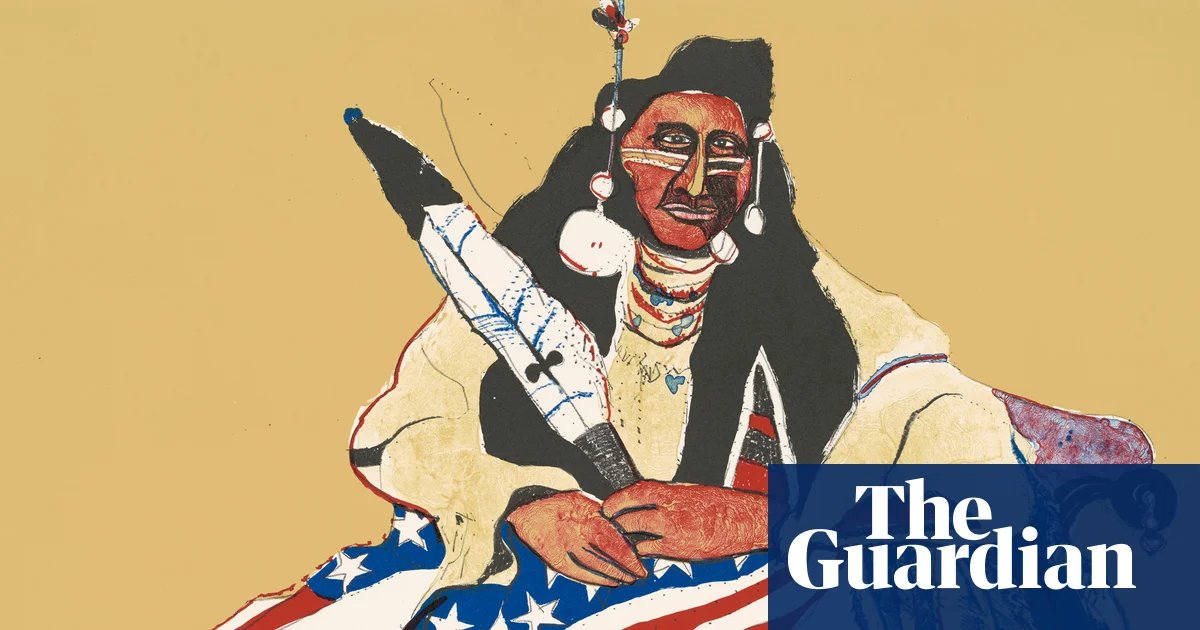
This section also contains Tom Jones’s 2002 mixed-media piece, Dear America, which was the inspiration for the title of the exhibition. Jones, an artist of the Ho-Chunk Nation, overlays historic postcards and snapshots of Indigenous people with lyrics from the patriotic anthem My Country, ’Tis of Thee. Adorned with traditional glass beads and porcupine quills, the work is a pointed interrogation of how Native Americans have been represented – and erased – in popular culture.
The final act of the exhibition turns its lens to freedom. There are scenes from the American revolution and civil war, including Paul Revere’s print depicting the Boston Massacre of 1770, as well as historical portraits of figures such as Frederick Douglass, Sojourner Truth and George Washington.
Faith Ringgold’s striking 2007 screenprints, which illustrate Martin Luther King’s Letter from Birmingham Jail, sit near Parks’s soaring 1963 photograph of a Harlem rally, where a sea of hands is raised in a gesture that bridges political surrender and religious praise.
Kara Walker uses cut-paper silhouettes to expose the enduring traumas of slavery while Martha Rosler’s photomontage series, House Beautiful: Bringing the War Home, splices horrific combat imagery from the Vietnam war into pristine, glossy magazine spreads of middle-class American interiors, effectively destroying the suburban illusion that the brutality of war was far away.
As visitors exit, they are met with pop artist Robert Indiana’s boldly coloured screenprint Liberty ’76. Created for the 1976 bicentennial, the piece creates a “slippage between 1776 and 1976, speaking to the ongoing pursuit of freedom”, Ramos says. “That one resonated with me as well.”