[ad_1]
Joseph Francis was going through a tough stretch when he had his first creative epiphany.
Francis had been working as a chef in New York for the better part of two decades, including stints at several high-profile Manhattan eateries. As anyone who has ever spent time in the kitchen of an upscale restaurant will tell you, the cooking life is intense. The hours, the pressure and the work-hard-play-hard ethos can swallow people whole. Francis struggled with the excesses of the profession.
Those struggles led to a stint in rehab. “I was doing bad things for a long time, and I didn’t realize how it was affecting me,” he says. “I needed to retrain my brain and learn how to be sober.”
As he worked to get clean, Francis found sanctuary in the rehab facility’s art room. He began painting and drawing, which he hadn’t done with any regularity since he was a child.
With rehab behind him, Francis kept creating. He was living and working in Greenport after the darkest days of Covid when he experienced what he calls his “lightbulb moment.”

One day, he came across a reproduction of the original 1975 movie poster for Jaws. The oversized Great White with massive teeth hovering below a female swimmer who is completely unaware that she’s being hunted is still one of the most iconic images in movie history.
Francis had seen the poster many times before, of course. But this time was different. There was something about the contours of the shark’s mouth and teeth that spoke to him.
“I looked at that sheath and I saw Jaws,” he says. “I’ll never forget that feeling.”
Wouldn’t the Great White’s menacing maw look interesting painted onto the triangular tip of the sheath of one of his chef’s knives? he thought.
And wouldn’t the process of creating imagery on a knife sheath signify something unto itself?

What would a decorated sheath (also known as a “saya”) mean to professional chefs, whose knives are not only the tools of their trade, but also an integral part of their identities in the kitchen?
Francis wasn’t asking himself those detailed questions at the time. The meta-analysis and navel-gazing would come later. He was just an artist having a moment – making things because he was compelled to make them.
It was the beginning of a creative journey that has led to an entirely new career.
Francis knew there was an opportunity in the work he was creating, but he stayed focused on his craft. “Every day I studied how I could do this better,” he says. “And early on, I actually did start thinking of it as a business – that seemed like the light at the end of the tunnel.”
Soon, he was creating custom ink transfers and using wood-burning techniques and a variety of materials in addition to paint to create an ever-growing inventory of unique hand-decorated sayas.

He launched Mojo Studio in 2023, first as an online business selling mostly to fellow restaurant professionals. Many of his designs draw from popular culture (movies, music, comic books) and the world of celebrity chefs (Anthony Bourdain, Emeril Lagasse, even Julia Child, who he depicted in a bikini, and Marie-Antoine Carême, who cooked for Napoleon and at least one Russian Czar). But his work also explores the deeper crevices of his imagination.
A New Jersey native, Francis had put together a nice culinary resume, including stints at Danny Meyer’s Eleven Madison Park and the Ritz-Carlton in midtown Manhattan. Most recently, he was the head chef at Claudio’s Waterfront in Greenport.
“I worked really hard as a chef, and I made a promise to myself that I would never let my art interfere with my job,” he says. “I wanted to be Mojo Studio online and Chef Joe at work.”

But there comes a moment in many working artists’ lives when they have to take a leap of faith – when they have to decide whether to leave their familiar livelihoods behind and embrace their art full-time. In Francis’s case, that time came late last year.
The process happened almost organically. A hip, second-floor space with an inviting staircase and great energy became available in a commercial alley just off Front Street, Greenport’s main drag.
Francis took possession of the space last November. But even after he’d signed the lease, he had to convince himself that he was ready to stop cooking professionally.
“Being a chef has always been a big part of my identity,” he says. “But I told myself, ‘I did a lot; I got a lot accomplished [in the restaurant world]. It was time to move on.’”
Leaving part of his past behind while moving into the Front Street space also turned out to be the impetus for an important new phase of his creative life.

Greenport’s main drag.Bob Giglione
Francis worked non-stop over the winter of 2025 and into the spring of 2026 to create a public-facing studio/retail store. “Those months really lit a fire under me,” he says. “I needed to prove to myself that this could be done.”
It was during those months that he had a second artistic epiphany. Beginning with the creation of his Jaws-inspired saya, he had spent the last few years making beautiful and unique sheaths by hand. Now he began to create custom knife racks which integrated the artwork on the sayas into a cohesive whole.
Soon, the walls of his studio were filled with pieces that function as both knife racks and standalone works of conceptual art.
“Walk of Shame” is one of Francis’s favorites. It’s a mixed-media art rack that combines hand-painted elements and layered collage. The image features bold reds and blacks with a striking central figure. The one-of-a-kind saya is adorned with decoupage featuring a geisha, floral motifs and vintage patterns. The knife itself is an 8-inch, 67-layer Damascus kiritsuke with a red desert ironwood handle.
“Have a Good Service” – one of this writer’s personal favorites – is a 16 x 20-inch wooden canvas artwork featuring a bold, darkly comic interpretation of the organized chaos in a professional kitchen. The centerpiece is a watchful “mad chef” who anchors the scene. Mounted below, an 8-inch saya is adorned with a “ticket spike” motif, complete with a pierced finger — a restaurant insider’s nod to every line cook’s reality. The “Have a Good Service” message completes the narrative, encapsulating the adrenaline and dark humor of life in a demanding professional kitchen.
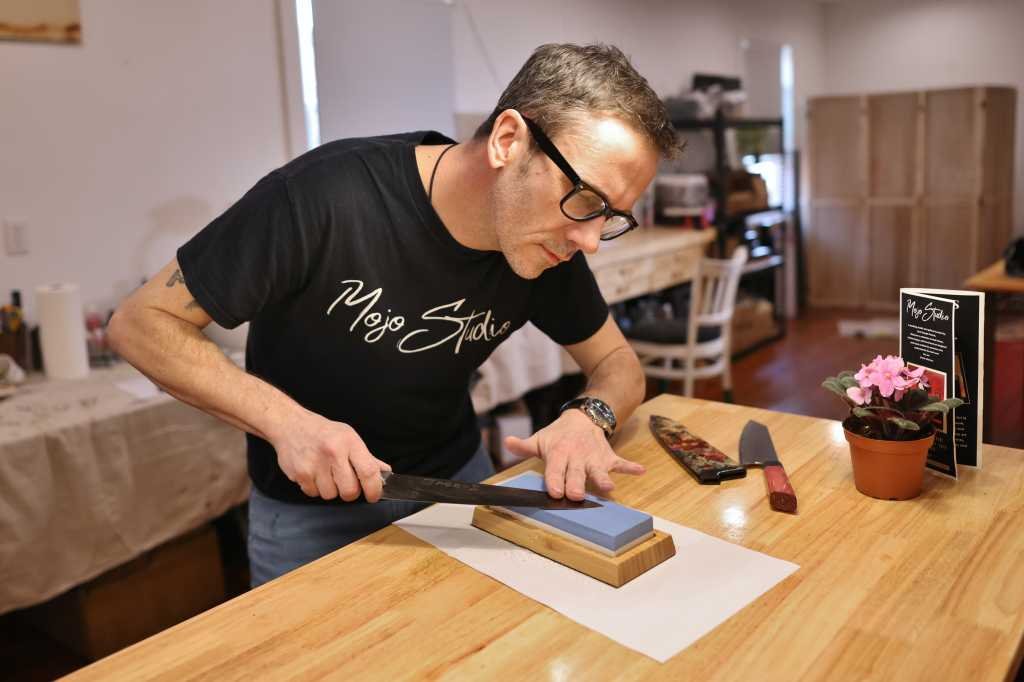
In addition to his ever-growing collection of sayas and wall art, Francis sells the actual knives – fine chef’s instruments that do his sayas justice. He also offers professional knife-sharpening services.
As he gears up for his first summer season as a full-time working artist in Greenport, Francis feels like he’s in a very good place.

that function as both knife racks and standalone works of conceptual art.
“The first weekend I opened my doors was so exciting,” he says. “It was like a ball of energy that defies explanation. Sometimes I think to myself, ‘Oh my God, Memorial Day, 4th of July, Labor Day. The amount of people who visit this area from all over the world… the possibilities are endless.’”
It’s clear that the anxiety Francis felt about giving up his professional life as a chef continues to recede. “The voice I did not have in the kitchen I have now in art,” he says.
Visitors to Mojo Studio might not notice a small index card Francis has tacked to the wall facing the window. It’s a short note he wrote to himself while he was creating the latest chapter of his life.
“The late nights, the behind-the-scenes work nobody ever sees, is what makes the average man into who he really is,” the note says. “Lean into your silence and be not afraid. Soon will come the day you wish you had it back.”
Email tvecsey@danspapers.com with comments, questions, or tips. Follow Behind The Hedges on Facebook, X and Instagram.
This article appears in the Memorial Day 2026 issue of Behind The Hedges in Dan’s Papers. Tap here to read the full edition. For more Master Craftsman columns, click here.
[ad_2]
Source link