[ad_1]
Does the business of selling a work of art have anything to do with its value? It’s a complex question, and one Houston gallerist, secondary market art broker, and fine art appraiser, Heidi Vaughan, is uniquely qualified to answer.
Located on Lake Street at Colquitt, along Houston’s oldest gallery row, Heidi Vaughan Fine Art (HVFA), is small in square footage, but formidable in its reach and reputation. It is a traditional gallery, representing a diverse array of Houston-based established artists, including McKay Otto and Thedra Cullar-Ledford, and several emerging creatives, each pushing their respective mediums in surprising directions. New to the fold is Houston painter Afi Lane, who creates striking portraits of Black people elegantly poised in historical costumes adorned with symbolic objects and modern-day accoutrements. HVFA also advises on all aspects of art collecting, including sales, the creation of cohesive collections, valuation, authentication, conservation, framing, installation, display, shipping, storage, deaccessioning, and liquidation.
From appraising art destined for inheritance to advising first-time collectors on their first-ever purchase, Vaughan’s multifaceted role requires a thorough knowledge of art history, a critical eye, and a genuine sensitivity to the emotional and financial well-being of her clients.
“AI is not taking my job,” says Vaughan with a smile, and she’s right.
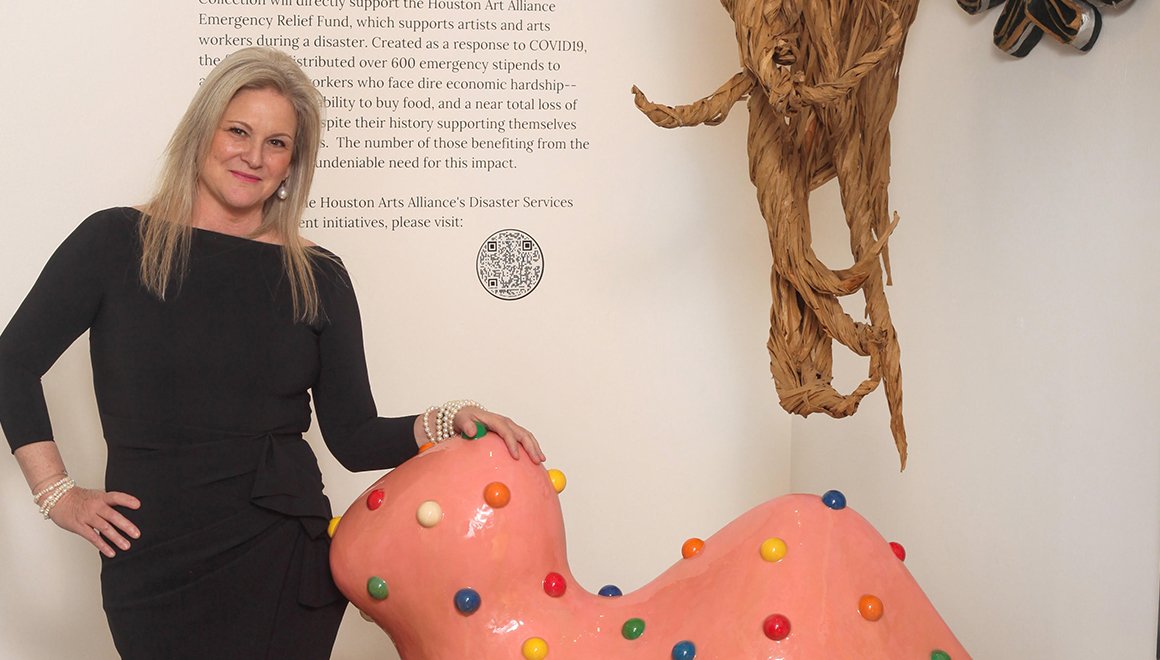
With her trademark silver blonde mane and Louis Vuitton x Jeff Koons Mona Lisa purse, Vaughan is an immediately recognizable figure when out on the town. She is the one gallerist I’m most likely to see when I’m out at a special event, be it a museum exhibition preview, a music performance in the woods of Splendora Gardens (Vaughan studied flute and piano as a child, and her sister is a professional concert oboist), or a fancy gala. Her presence as an advocate for the arts extends well beyond the square footage of her gallery.
On her lively radio show, The Houston Hour, which currently airs on Wednesdays at Noon on 90.1 KPFT HD2, Vaughan and her co-host, Houston historian Mister McKinney, divide the hour between conversations with members of the city’s creative community and those deeply connected to its rich history. She’s also a fan of art writing, be it online or in books, magazines, or newspapers. (She is a Houston Chronicle subscriber, and at one point, our conversation veered to a recent article in the Sunday Arts Section of the New York Times about Paris Fashion Week.)

While Vaughan is not shy about discussing the business and pleasure of selling art, in conversation, it’s clear that what she values most in an artist’s work is its power to engage and transform the viewer and speak to a better future. I started our conversation by asking about the previous weekend’s opening of McKay Otto’s show GOLD.
Heidi Vaughan (HV): It was one of the best parties we’ve ever had. Because McKay has been doing this for decades, the opening brought in some of the most important collectors from throughout the history of Houston. If you’ve ever been here on a Saturday night during one of our openings, it gets crazy crowded. And when I’m stuck back here (behind the front desk) with my cash register, I’m in my happy place. I don’t care how busy it is; if I’m bringing in money, that’s making me very happy.
Chris Becker (CB): So, sales are happening, even in a partylike environment?
HV: Oh, yeah!

CB: Why do you think McKay’s work has connected with so many collectors?
HV: There are several reasons. One, he’s just beloved. He’s been in Houston since the ’80s, and a lot of people know him. He has a lot of friends.
I endeavor to work with artists who make work that is uplifting. There’s a lot of great art out there that’s making great commentary about modern times and the society we live in, and some of it might be something I’d like to look at in a museum, but it’s not something I want to live with or want to sell. This body of work by McKay (GOLD) is all about the light. The paintings have phosphorescent pigments beneath the surface, and they glow in the dark in a beautiful, subtle, meditative way.
I think it’s the right time for this kind of art. We are at this point where society has become so nuts, and there’s so much darkness around the world. But if you look at everything that’s going on with the arts, it’s so uplifting, and such a wonderful counterpoint to all of the heaviness going on. And when I think about people going to Bruce Springsteen’s concerts, or Coachella, and those puppet shows (Bob Baker Marionette Theater) — this is stuff that really lifts our spirits, and we need as much of it as possible.
CB: Do you introduce your artists to potential collectors?
HV: Absolutely. I always tell the artists I represent that the person who is most likely to buy your work is someone who has already bought your work. We know that they get you, and they like you. My artists, at the end of every year, get a spreadsheet with all their sales, including the name, email, and phone number of each person who bought their work. So, when they have the next show, that’s our VIP list for that particular artist. But not all galleries do that. In fact, I’ve heard artists say they don’t even know who owns their work, which I think is horrible.
My favorite thing is selling art to new collectors. I love helping people who have never bought art before to feel confident about the decisions they make. As an appraiser, I’m able to help them understand why purchasing one thing might be better than purchasing something else elsewhere.
CB: Who are your collectors?
HV: I sell art to all kinds of people, of all ages. My oldest client was Jay Marks, Lester Marks’ father; he lived to be 101 . He got art for his 99th birthday from my gallery. And if you think he didn’t have plenty of art, he did! But it’s always nice to have something new to look at.
One very rare thing is when people who don’t know me, who’ve never been here, and don’t know the artist, walk into the gallery and say, “Oh, my God. I love it. I’ll buy it!” Usually, it takes a while to develop a relationship, and when I know my clients and what they like, I might get something in and tell them, “I know this is for you!”
There are terrific collectors in Houston. Last year, I sold a photography collection that one of the top photography appraisers in America valued at $11 million. That’s really fun and exciting. I feel like the best deals are the ones where everyone walks away feeling like they won. I make a lot more money doing that than I do with the primary market. Which isn’t to say I don’t love the primary market. I do. But it’s a combination of all of it.
I also sell art on Artsy, an online, global platform, to people I don’t know. But I wouldn’t typically use Artsy to sell art by my artists. I sell secondary market art as well, works by artists that everyone knows, like Damien Hirst or Takashi Murakami. That’s the kind of stuff I sell to people I don’t know and who don’t live in Houston.
CB: What exactly is the secondary market?
HV: Art that has been bought once, maybe even more than once, and is available for sale.
CB: And the primary market is artists represented by Heidi Vaughan Fine Art.
HV: Yes.

CB: What factors do you have to consider when appraising a work of art?
An appraiser is held to the same standards as an accountant. People are surprised to find out this isn’t random, that we don’t just pull a number out of thin air! (HVFA is an accredited member of the International Society of Appraisers and is compliant with the Uniform Standards of Professional Appraisal Practices.)
Number one, for me, is the image itself. You can have a work of art by an artist you really care about, but maybe it’s not a particularly good image. It’s the main reason why someone might choose not to get something: they just don’t like the image. Who comes to mind immediately is Picasso. He made some rough stuff! He made some very unattractive things. But appraisers don’t use words like “beautiful.” We use “good,” “fair,” and “poor,” and we define what those words mean. We don’t use superlatives.
There’s also a hierarchy of materials that determines value. We tend to think of oil on canvas as being the “king daddy.” Maybe oil on panel, depending on the work. A watercolor is often more valuable than a print. A drawing might fall in the middle somewhere. If we’re looking at sculptures, a bronze or marble sculpture is going to have more value than an aluminum sculpture.
Also, rarity. Is it editioned? How big is the edition? Provenance is another one. We need to know the work is authentic and who owned it previously.
And the notoriety of the artist definitely contributes to the value. If we’re thinking about artists from Houston, I consider what exhibitions they’ve been in. If the work has been in an important museum show, that matters. One exhibition we think about a lot is Fresh Paint: The Houston School. That was such a pivotal show in 1985 at the Museum of Fine Arts, Houston, that it went on to be exhibited at P.S. 1 Contemporary Art Center [now MoMA PS1] in New York. Those artists are still important. It was a great exhibition, and I’ve handled some of the works featured in the book Fresh Paint: The Houston School, by [the exhibition’s] curators, Barbara Rose and Susie Kalil. Susie’s book The Color of Being/El Color del Ser: Dorothy Hood, 1918–2000 has had a tremendous impact on the value of Dorothy Hood’s work. I’ve seen Hood’s drawings go from $8,000 to $28,000. The value of her paintings has just skyrocketed.
CB: Because the book brought more exposure to Hood? Or was it the scholarship in the book?
HV: Both. Susie is an exceptional art writer. It’s one of the books I look at the most. I use books around here a lot, because they do help people find a way to engage with the art.

CB: What compels you to reach out to an artist and offer to represent them?
HV: How it started in the beginning is that I invited people whose work I had already collected. I’ve been collecting art since the ’80s. I am my client. I buy this stuff, and I get irrational. I have to have things! (laughs) Things haunt me, and all of that.
CB: What kinds of art “haunt” you?
HV: Well, my personal collection is a Texas collection. I don’t have any bluebonnets, and I don’t have any longhorns, and I’m from Chicago. It’s art that is fun, uplifting, and maybe has a little humor to it. I usually buy something from every show we do. I’ve gotten to a point where that’s a little crazy, and unfortunately, I have art in storage.
What I love about art is that you can’t live in it. You can’t sail it. You can’t drive it. All you can do is look at it. And I love that someone is willing to spend money, sometimes large amounts of money, to just look at a work of art.
One of my favorite compliments I’ve received was from a man who called me the day after we had installed a painting in his house and told me, “I just want you to know that my wife and I stayed up until two in the morning just looking at it.” That made me so happy.
Growing Up Wise, a solo exhibition by multidisciplinary artist Vivian Wise, is on view at Heidi Vaughan Fine Art through June 20, 2026.
[ad_2]
Source link