[ad_1]
The twentieth edition of Art Dubai opened to VIP visitors on Thursday in a smaller format than originally planned. Delayed from its mid-April slot due to regional geopolitical unrest, the fair presented around fifty galleries, roughly 60 per cent fewer than the approximately 120 exhibitors initially expected. Despite the reduced scale, the opening day drew a strong crowd, with the majority of collectors in attendance from the Gulf states and the wider Middle East.
The trimmed-down edition reflects both the disruption caused by the delayed opening and a recalibration of what the fair does well. With a more regionally focused selection of galleries, Art Dubai 2026 leaned into its strength: a genuinely engaged local and regional collector base that does not need to be flown in. For all the international ambition that has surrounded the fair in recent years, the opening day demonstrated that the foundation of its market is firmly rooted closer to home.
Art Dubai has a particular claim on fair history as the first major international art event to resume in-person operations during the Covid pandemic, a moment that reflected the UAE’s approach to crisis management and one that many in the regional arts community still point to as a turning point in how seriously the country’s cultural sector was taken internationally.
Away from the fair itself, the broader Dubai art market continues to show signs of consolidation and growth. A new gallery, 971 Art Gallery, has established itself in the city’s Art of Living Mall in Umm Suqeim, occupying a 600-square-metre space that positions itself at the upper end of the Dubai market, targeting collectors, interior designers and institutions seeking significant contemporary works with both cultural and financial weight.
The gallery’s programme centres on a roster of international artists whose work spans photography, painting, mixed-media and glass-based practice. Among the most prominent is French artist Gérard Rancinan, known for large-format staged photographs that use the visual language of art history and contemporary spectacle to examine modern behaviour and collective mythology. His work has a scale and theatrical ambition that suits the kind of architectural spaces the Dubai market tends to favour, and the gallery launched with a dedicated exhibition of his work titled A Visual Odyssey.
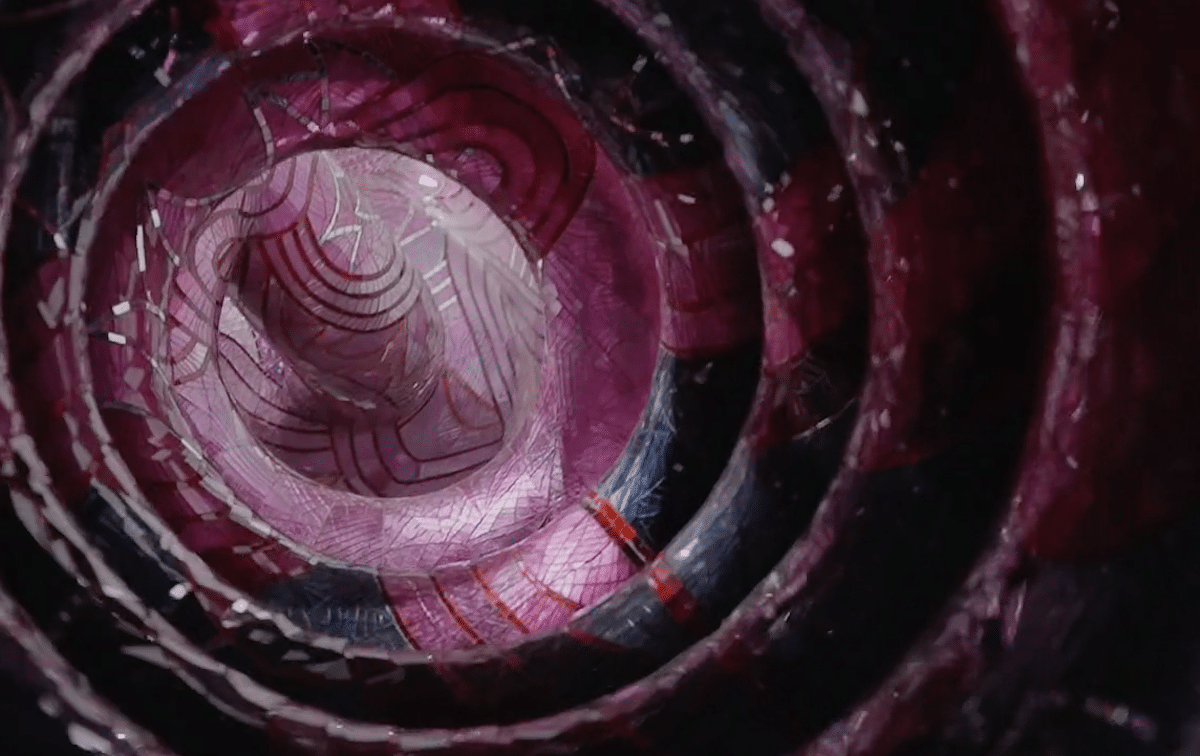
Also represented is Belgian artist Isabelle Scheltjens, who constructs portraits from thousands of individually cut pieces of coloured glass. The technique produces works that function differently depending on the distance from which they are viewed: close up, they read as dense, highly textured abstractions; from a distance, they resolve into hyper-realistic faces. It is a demanding process, and the results occupy an unusual position between craft and conceptual practice that tends to hold collector attention.
The gallery’s programme also includes the Italian artist Riccardo Gusmaroli, whose paper-boat compositions operate in a quieter register, and Peruvian painter Benito Cerna Leon, whose canvas-based work has been making inroads in the regional market. Michele Tombolini, whose practice sits somewhere between social commentary and pop art, rounds out a programme that is deliberately international while remaining accessible to the Dubai collector base.
What 971 Art Gallery is doing is not dramatically different from what several galleries across the city have been attempting for several years: positioning Dubai not merely as a place to sell art but as a place with its own collecting culture and institutional seriousness. The gallery offers curatorial advice, collection management and logistical support alongside the works themselves, reflecting the reality that a significant portion of buyers in this market are newer collectors who want guidance as much as they want objects.
The fair, even in its reduced 2026 format, remains the most visible of the city’s ambitions to position itself as a hub for contemporary art in the region. The decision to proceed with a smaller edition rather than cancel entirely speaks to confidence in the local market’s ability to sustain the fair independently of the international galleries that did not make it this year. Whether collectors from further afield return in larger numbers in future editions will partly depend on the geopolitical situation, but the opening day crowd suggested that regional demand alone can fill a fair of this scale.
For galleries like 971, the timing is calculated. Opening in a city actively building its art market infrastructure, with a programme aimed at collectors who may be acquiring seriously for the first time, represents a bet on the trajectory of the Dubai market over the next decade rather than its current position. The space and the programme are designed for a client who wants museum-quality work in a domestic or corporate context and is prepared to pay accordingly.
How that bet plays out will depend on factors well beyond any single gallery’s control. But the opening of Art Dubai’s twentieth edition, even in its scaled-back state, confirmed that the appetite in this city for genuine quality in contemporary art has not diminished. Watch this space for a sales update.
[ad_2]
Source link