[ad_1]
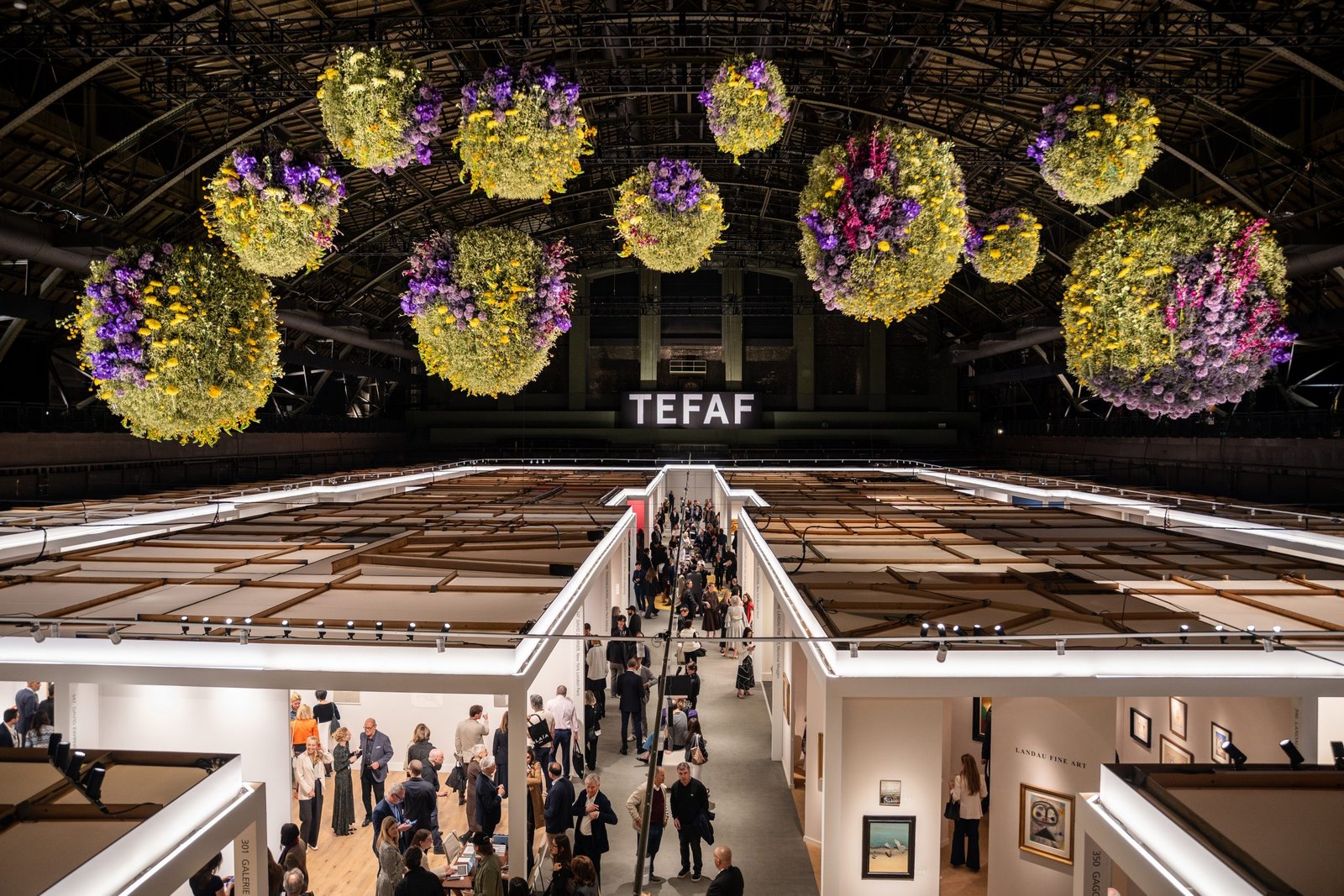
The opening day of TEFAF New York was nothing short of mobbed, one of the seemingly unavoidable consequences of staging an international art fair in the comparatively compact Park Avenue Armory. This is more than made up for, however, by the opportunity to catch a rare glimpse of the Armory’s historic second-floor period rooms—which are transformed into concise, Gilded Age showrooms.
Perennial visitors of TEFAF Maastricht’s younger New York sibling can generally count on seeing a few things year after year, like an Alexander Calder mobile, an Alighiero Boetti “Mappa” or “Arazzi” (likely both), or a Josef Albers “Homage to the Square,” just to name a few. This year, of course, is no exception.

Photo: Vincent Tullo. Courtesy of TEFAF New York.
And for those of you who missed Hauser and Wirth’s inaugural exhibition in Basel on cult-favorite Vilhelm Hammershøi in 2024, the gallery has dedicated its booth at the fair to the Danish artist’s signature quiet interiors.
Iconic, canonic works are largely what the fair is known for but situated among the cacophony of recognizable-at-first-glance pieces are alternating moments of true discovery as well as (increasingly) the debut of new work by contemporary artists.

Kathleen Ryan, Bad Cherries (Princess) (2026). Photo: Jitske Nap. Courtesy of TEFAF New York.
Solo Standouts
Glittering just inside the entrance to the Wade Thompson Drill Hall are an array of larger-than-life bejeweled fruits by art world darling Kathleen Ryan. Gagosian (stand 350) has dedicated the entirety of their booth to presenting all-new sculptures by Ryan, the newest iterations of her “Bad Fruit” series begun in 2018.
Ryan is one of those artists whose work, though thematically a bit predictable, is never boring and always a visual delight—from a human-scale slice of cantaloupe encrusted in freshwater pearls, rose quartz, agate, and carnelian, to equally opulent, though rather deflated, grapes fixed to copper piping stems. Staged within the context of TEFAF New York and juxtaposed with the historic (even ancient) works that populate the fair, it invites considerations of Ryan’s work not just within the present moment but within the greater arc of art history, which at this point in her career is more than due.

Installation view of work by Eva Helene Pade at Thaddaeus Ropac. Photo: A. Olen.
Another solo standout that has already created significant buzz is Eva Helene Pade at Thaddeus Ropac (stand 345). Showcasing three monumental new canvases by the Danish painter, the presentation follows on the heels of her first solo, “Søgelys,” or “Search Light” in London with the gallery last year. Booth design plays an impressive role here, bringing the works off the wall and the two larger works angled toward the central piece create a chapel-like site for her ethereal, operatic compositions.

Installation view of work by Ida Barbarigo at Axel Vervoordt. Photo: Jitske Nap. Courtesy of TEFAF New York.
On the other end of the spectrum of recognition is a beguiling solo presentation on historically overlooked Italian painter Ida Barbarigo (1920–2018) with Axel Vervoordt Gallery at stand 206, one of the shadowy, atmospheric upper period rooms. Installed on the room’s intricate steel latticework, Barbarigo’s paintings bear the spiritual resonance of both the Renaissance and ancient artists she was influenced by, as well as the experimental nature of 20th-century Modernism. Prices range between €15,000–€75,000 ($17,470–$87,350). Staging the booth as a solo was an astute and informative choice, introducing a broad scope of her work to a largely new audience.

Installation view of Galerie Patrick Seguin at TEFAF New York. Photo: A. Olsen.
Surprises in Collectible Design
Cross-category collecting is one of TEFAF New York’s greatest strengths, and no account of the fair would be complete without reference to the wealth of design it brings together.
In a stark departure from the expected furniture, lighting, or other decorative arts, Galerie Patrick Seguin (stand 331) is offering houses—expanding the already expansive list of fair categories.
Produced by self-taught architect and designer Jean Prouvé, who at one time counted Le Corbusier among his clients, 12 models of “demountable” architecture designed between 1939 and 1956 are on view in the center of the booth, and along the booth walls are explanations of their names, individual specs, and characteristics. Each model reflects one of the full-size historic examples contained within the gallery’s inventory, which upon purchase can be reassembled wherever you might desire.
Among them, Villa Lopez (1953) and Valençaude school (1954) are being exhibited publicly for the first time ever. A fact sheet for presentation relays a quote by Prouvé: “There is no difference between the construction of a piece of furniture and a house.” From the perspective of TEFAF New York, Prouvé’s sentiment is pushed to the limit.

François-Xavier Lalanne, Canard (2008), presented by Paul Coulon. Courtesy of TEFAF New York.
And while the works of François-Xavier Lalanne may fit with the crowd mentioned above—Calder, Boetti, Albers—and perpetually pop up each year, they nevertheless continue to delight audiences and draw collectors. And there is now a certain revived energy around Lalanne following a the sale of a group of mirrors from the collection of Yves Saint Laurent at Sotheby’s in April, which soared past the high estimate of $15 million to achieve $33.5 million.
While several galleries showed more intimately scaled works within their booth, two Lalanne sculptures crept into the fair aisles. As the crowds parted on preview day, rather than find a cleared path to nimbly squeeze through, visitors came face to face with a colossal bronze duck on the north aisle and fish-bird-rabbit hybrid on the south—but is not half the beguiling allure of Lalanne an element of surprise?
TEFAF New York is on view through Tuesday, May 19, 2026.
[ad_2]
Source link