[ad_1]

Listen to this article
Estimated 4 minutes
The audio version of this article is generated by AI-based technology. Mispronunciations can occur. We are working with our partners to continually review and improve the results.
An old Greenlandic story tells of a cannibal known to eat the flesh of his wives, before his seventh wife seeks redemption and kills him. The tale’s heroine, Masaannaaq, serves as the inspiration behind Iqaluit-based artist Laakkuluk Williamson’s first solo exhibition, Nuliaminik Neqilik.
“Drawing parallels about how, as Inuit women, as Indigenous women, as racialized people, we have to do this, really calling into the depths of ourselves to take up physical space in this ravenous world that we live in,” said Williamson, a Greenlandic Inuk artist.
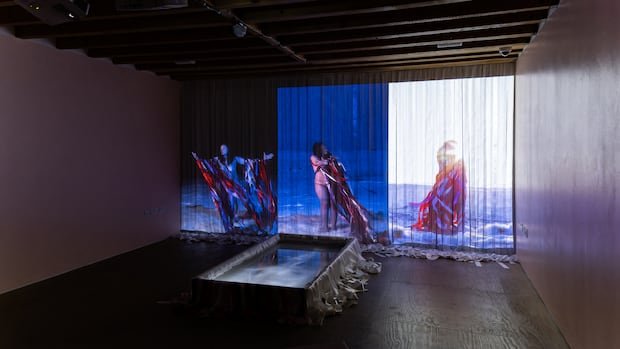
Williamson uses the tale as a metaphor for Inuit rebelling against colonial powers. The exhibition, currently at London’s Mimosa House gallery, incorporates beadwork, photography, vocal performances and even enlarged replicas of historic Inuit objects housed at the British Museum.

The collaboration didn’t end with the replicas, as Williamson opened her exhibition with an immersive performance at the British Museum.
“I think that for me was just so kind of earth-shattering … because here’s this very colonial institution [the British Museum]… And then they had Laakkuluk in there with her physical presence and just welcoming, but also shaking things up,” said Inuk artist Taqrilik Partridge, who served as a curator on the project.
Bringing Inuit to London
Despite being her first solo exhibition, Williamson’s name was already known in Canadian artist circles long before Nuliaminik Neqilik opened in late April. She won the 2021 Sobey Art Award for emerging artists, with her work featured in the National Gallery of Canada.
Williamson was chosen to create the new exhibition by Partridge, who says that given Williamson’s prominence, she felt the work would resonate well in an international space.
Nuliaminik Neqilik’s themes of feminism and identity are also a good fit with the Mimosa House gallery and its focus on women and queer artists.
Kirsty Ogg, Mimosa House’s interim director, said the exhibition deals with many issues.
“It touches on ideas around body size and body image, and the way that women, in particular women’s bodies, there’s systematic injustices attached to the way that they are treated, attached to colonialism, racism, capitalism and the patriarchy,” said Ogg.
“I think that’s where the strength of the story lies.”
Ogg says that housing Inuit art at the gallery is particularly important at this moment in history, as international leaders increasingly set their eyes on protecting, and expanding, their countries’ strategic operations into the circumpolar region.
Nuliaminik Neqilik is open to the public at Mimosa House until June 27. After, the exhibition will travel to the Nuuk Art Museum in Greenland, before setting up at the SAW Centre in Ottawa.
From England to the world
For Partridge, the exhibition is part of a broader trend of showcasing Inuit art both in Canada and internationally.

“For me, to be able to be a small part of that and to do something that I think is meaningful and that I feel is meaningful for my community — that is really where my satisfaction lies,” Partridge said.
Williamson says working with the British Museum on an exhibition that reflects on colonialism was surreal. She called her opening live performance at the museum “bizarre and melancholy and beautiful at the same time.”
Williamson also says the opportunity to tour her exhibition internationally is something that “means the world,” particularly having the opportunity to show works to her family in Greenland.
She’s especially pleased to bring one installation based on the first polar bear her family caught in living memory.
“It’s not common in our family,” Williamson said. “So for that piece and the polar bear hide to go visit in Greenland, and be able to visit with my family members there, I find that such an amazing journey for this little bear to go through.”
[ad_2]
Source link