[ad_1]

Most people who grew up in the pre-internet age first developed their imagination through visual narratives they encountered in picture books filled with images of fairy tales or animal stories that could open an entire world without written language. Archie Rand’s newest body of work, which was recently on view at Jarvis Art in New York, harkens back to that engagement. His paintings reclaim the form’s primordial function, demonstrating the connection between brain and hands, between imagination and reality, replicating the miracle of creation and opening entire worlds.
In his first extensive solo show in years, the recent exhibition paid tribute to Rand’s unique position within the art that emerged from the downtown scene in the late 1970s and early ’80s. Now in his late 70s, Rand witnessed the full postwar evolution of American art, participating closely in it while always retaining a critical distance that allowed him to develop a voice and style resistant to trends. Speaking with him is like reading a firsthand account of art history written during New York’s golden moment—and, at the same time, a searching confrontation with what painting is and what it still serves in an age when all experience is being digitized.
“I was part of the generation that came after Robert Rauschenberg and Jasper Johns; at that time, the distinction between abstraction and representation had already begun to blur,” Rand tells Observer. He fell into the group led by critic Clement Greenberg, then enormously powerful and a major champion of Jackson Pollock, and found himself aligned with that trajectory without truly fitting into it. Rand was only 18 at the time. “I became something of a mascot—the young kid who was going to carry the message forward,” he jokes. Yet, with the confidence of youth, he eventually realized that if he was only 18 and understood it, it couldn’t be that hard. Something must be missing.

A pivotal moment came with a large synagogue mural commission, which forced him to confront the absence of established Jewish iconography. Inventing that imagery led to backlash. “As I began doing that, the Orthodox community became very angry. They actually put me on trial for blasphemy,” he recounts. This pushed Rand toward representational forms grounded in textual reference. Most importantly, this figurative shift marked a break with Greenberg, who viewed the move as a betrayal. From that point, the artist became acutely aware of the cyclical nature of the art world. “I began to understand, at a fairly young age, that the art world operates in cycles, much like fashion. Styles rise and fall, and people replace one another,” he notes.
After being rejected by both the Orthodox community and Greenberg’s avant-garde circles, Rand found allies among figures similarly marginalized at the time, including Philip Guston and John Ashbery, both of whom were challenging prevailing aesthetic norms, in painting and poetry, respectively. “In the last five years of his life, Guston and I became very close. He saw me as a mural painter—someone bringing representational imagery into painting in a non-academic way,” Rand says. “I jumped ship in two ways—literary and visual—and found myself free to do almost anything.”
Another major turning point came ten years ago, when his wife fell ill and died. “I never thought of myself as old, but after my wife passed away—we had been married for 55 years—I became aware of my own mortality.” Around the same time, he began noticing that many artists he knew, as they grew older, had started returning to elements from their childhood. “I saw this pattern in others. My friend Malcolm Morley was painting images of London after the Blitz. Allen Ginsberg spoke about wanting to return to the room where he was born. Guston returned to the cartoon imagery he first learned through correspondence courses. The musician Cecil Taylor rejected structure, saying, ‘Why do I have to wait four beats to play this note?’ I realized that people I was close to were returning to formative experiences. After my wife died, I began to think: I’m going to die too. And after all the analysis—art history, technique, theory—what remains?”
This led him to question the intellectualized nature of contemporary art and its strategic formalization. “So much of contemporary art is about demonstrating intelligence, signaling knowledge,” Rand reflects. “Paintings become like business cards: the artist and viewer recognize each other’s sophistication, shake hands, and move on. It’s a kind of game.”

Rejecting this model, Rand turned back to the origins of his own visual sensibility, the source of all his imagination: his childhood fascination with illustrated books. “I began asking myself: what did I know about art before I knew how to analyze it? Before I understood good or bad, before teachers explained light, form, or history… what drew me to images as a child?” His father had a vast library, mostly late 19th- and early 20th-century books filled with powerful visual storytelling by illustrators like N.C. Wyeth, Howard Pyle and Walter Crane, along with authors like Rudyard Kipling and Nathaniel Hawthorne. “My mother would tell me to go read, and I would—but really, I was waiting for the next image. I would read just to reach the next illustration.”
For him, the act of looking—prior to language and, with it, analysis, theory or judgment—became central again. And in a contemporary moment shaped by A.I. and uncertainty around image authenticity, this return is a search for something more essential and real. “I don’t see these paintings as nostalgic or wistful. I see them as a kind of lifeline—something to hold onto so as not to drown. Images today can be manipulated so easily,” he reflects. “Ever since the 1950s and 60s, this has been accelerating. So I feel the need to return to something grounded in imaginative recall—where an artist is illustrating a narrative.”
The books that shaped his imagination were, according to Rand, also his first technology. What painting can do, perhaps, is restore the power of visual storytelling—of communicating through images before language intervenes. His new series encompasses approximately 80 works. They operate structurally like a novel or a symphony, he explains, with each painting contributing to an overarching narrative that presents archetypal characters and universal existential situations.
There is something appealing, even playful, in the colors and figures, but also something uncanny and grotesque—almost like James Ensor, where social commentary is embedded in an uncannily naive yet revelatory visual language. “They all exist in a space that is potentially comic and potentially tragic at the same time,” Rand acknowledges.
In Moon, a man in a nightgown stands in the street in the middle of the night beneath an expansive moon, looking up at a window where a clown figure appears to respond to his call. “Anyone could have been at that window. It’s the middle of the night, and someone has stepped outside under this enormous moon to ask for advice. That figure could have been a wise person, a beautiful figure, but instead, the person is asking a clown,” Rand says, noting that he did not construct these associations consciously. He describes them only in retrospect, yet at the time, everything felt completely natural.

In his search for essence and origin, Rand wanted to re-enter the open space of drawing’s immediacy and make it inhabitable. “I wanted to create paintings that you could enter, not because they are realistic, but because they feel present in a different way. When I finish a painting, I want to be able to step back and feel that I could walk into it,” he argues.
His images feel alive, as if an event is unfolding before your eyes, characters stirring into motion as you look. Imagination does the rest, expanding the scene into what came before and what will come after. “I wanted them to be livable,” he points out, agreeing that these are not simply figurative paintings—the figuration remains open-ended, offering something more to the viewer. Like fairy tales, someone begins telling you a story, and then you start imagining what comes next. The painting leaves space for that, for wondering where the narrative is going, what happens beyond the frame.
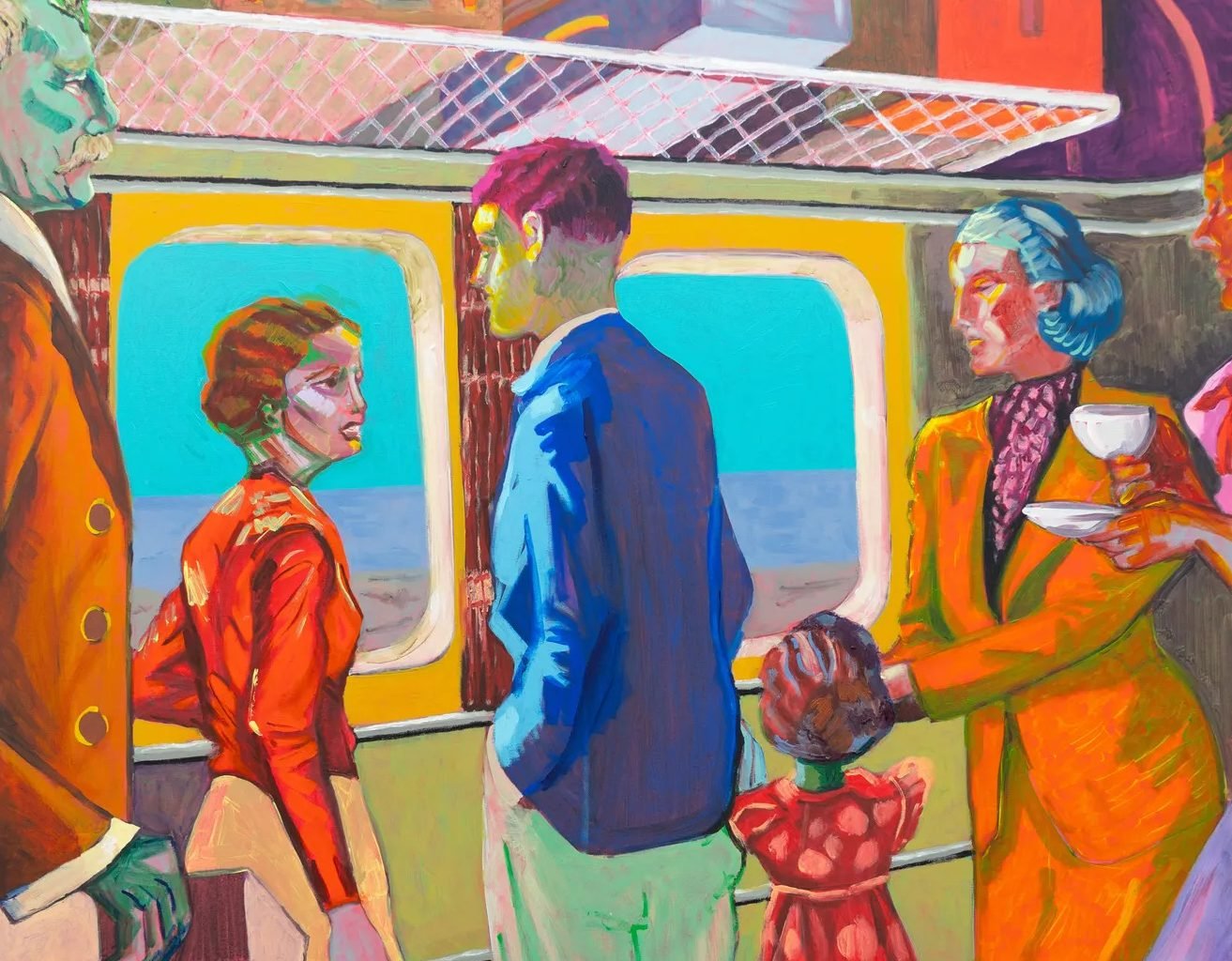
Take Travel, an image that recalls the cinematic and photographic archives of transatlantic crossings, when migrants left the Old Continent in search of freedom and prosperity in the New World. Its highly saturated tones suspend the scene in a kind of hallucinated memory, a sudden return to a past we have not lived but have nonetheless absorbed, inherited and learned to picture. Beneath this luminous surface, a quiet sense of precarity persists: in the stack of suitcases, in the charged silence between the couple as they look toward the horizon, in the stillness of a young girl who gazes out at the sea without yet knowing what awaits her beyond that line. A future of possibility, perhaps, or something closer to catastrophe. The painting unfolds as a dense narrative field that resists resolution, inviting the viewer into a space where characters and symbols feel at once familiar and elusive. Refusing fixed interpretation, it expands into a universal image of passage and transformation, unmoored from any single time or place.
“What’s remarkable is that everyone in the painting understands the narrative, except the viewer, as you’re the only one left outside. You’re essentially walking into something already in progress,” he says. “That’s what I mean by making a painting livable. I don’t put the brush down until I feel like I’m physically inside the space—like I’m standing six feet behind a figure, or 20 feet back within the scene.”

Rand remains convinced of the unique, imaginative and generative power of painting, which he believes no new technology will ever replace. Despite the proliferation of new media, he argues, these emerging technologies have not yet acquired the historical depth or “specific gravity” necessary to rival painting’s cultural and psychological weight.
At its core, Rand sees the power of painting as part of something fundamental—an almost instinctual human impulse to create and respond to images, one that may predate language and even extend across species: People are working in all kinds of electronic formats now, but there’s something about painting that feels almost prehistoric—and I mean that literally. This goes back to cave painting—you can imagine someone marking the wall and saying, ‘Look, a bull,’ as a way of invoking something essential, perhaps even survival.”
Painting is also something available to everyone, he adds. “A child on the beach can take a stick and draw in the sand, turning nothing into something, even if it’s temporary. That manual act carries necessity within it—it’s not incidental.”
Something deeply embedded in us drives both the making of images and the responding to them. Central to this, Rand points out, is the role of the hand: unlike mechanically produced images, paintings retain a direct trace of human presence, fostering intimacy and even reverence. Rand describes this connection as a form of secular devotion, rooted in the labor and concentration embedded in the work.
“What we don’t often acknowledge is that, until about 200 years ago, painting functioned within a hierarchical or religious framework. People would stand before icons in churches—not as an act of idolatry, but as a form of communication. They weren’t speaking to Christ directly, but through the image. The painting became a kind of prayer mechanism,” he reflects, noting how painting still operates at a conversational level. “When you look at a painting, you intuitively understand that someone made it by hand. The labor and concentration embedded in it signal that something necessary needed to be expressed. That alone creates a kind of reverence, even before you interpret the narrative.”
To illustrate this, Rand recalls a childhood experience with a painting of Joan of Arc at the Metropolitan Museum of Art, where he felt compelled to speak to the figure as if she could respond—underscoring the enduring capacity of painting to evoke presence and dialogue, particularly for viewers unmediated by theoretical frameworks. “Even now, whenever I return to the museum, I often see a child standing in front of that painting. That’s probably why it has never been taken down. There’s something about it that continues to speak,” he says. “People need to see that someone believes in an image enough to make it, to spend time with it, to offer it as something to contemplate, to converse with. That’s why we go to museums: everyone who enters a museum is going there to have a conversation with someone.”

Ultimately, Rand situates painting within a long historical continuum, from prehistoric mark-making to contemporary practice, as the most immediate connection between hand and imagination—and the source of its lasting force. While movements like Pop art and Minimalism challenged the primacy of the artist’s hand, most notably through figures like Andy Warhol, they did so in response to perceived stagnation within earlier traditions. Nevertheless, the disappearance of the hand remains for Rand a critical rupture, underscoring what is uniquely at stake in painting as a human act of imagination and expression, beyond and before the present moment and sensation.
“I teach graduate students, and I review applications every year. I would say that 80 percent of applicants are painters. It never stops, no matter what people say. I lived through the whole ‘painting is dead’ argument—it didn’t work. Painting isn’t dead,” Rand emphasizes. “Children still draw. You can see toddlers with digital devices, yes, but you also see them with crayons, making marks. Kindergarten teachers still give them materials to draw on, to keep them engaged and to express themselves manually. The hand remains essential.”
That desire to make an image by hand may be temporarily overshadowed by other technologies, but Rand does not see it disappearing. “It’s a primordial need. And perhaps we’re only now remembering that art comes from there.”
More in Artists

[ad_2]
Source link