[ad_1]
Art Dubai became the first major art fair to launch a new section dedicated to digital art in 2022, an innovation that has inspired similar initiatives at Paris Photo, since 2023, and Art SG, which launched its Digital Spotlight earlier this year. But, as the world slowly catches up, the success of Art Dubai Digital is causing some to wonder what’s next for the digital art market. Will it always be a separate entity with a distinct collector base or could it one day make it onto the main stage?
Now in its fourth year, the fair is well placed geographically to lead the way in considering these questions. “The Gulf region has always been forward-looking, and Dubai, in particular, is deeply fascinated by innovation,” said Art Dubai’s artistic director, Pablo del Val. “Technology isn’t something peripheral, it’s built into the DNA of the city.”
The city’s huge investments into emerging technologies include the Dubai A.I. campus and its A.I. and Web3 Festival. As well as Art Dubai Digital, 2022 saw the inauguration of the almost impossibly oxymoronic Museum of the Future, which aims to predict rather than preserve. Meanwhile, the UAE’s capital, Abu Dhabi, is just this week launching teamLab Phenomena, a vast, permanent 183,000-square-foot complex from the Tokyo-based digital art collective teamLab.
The high-tech cultural offerings hardly end there. Across the Gulf more broadly, Saudi Arabia’s new digital art institute Diriyah Art Futures had a splashy opening late last year. Qatar Adventures, an immersive showcase of the nation’s landscapes and landmarks on the metaverse, attracted 15.9 million virtual visitors between November 2024 and February 2025.
But is all this technological transformation actually translating into collector interest? It has certainly created a welcoming haven for the young tech entrepreneurs and crypto investors who are most readily associated with digital collecting, many of whom come from around the world to work in the Gulf region.
When Art Dubai Digital first launched, one exhibitor, Mila Askarova, director of Gazelli Art House, noted how even among the “usual suspect” collectors “there were quite a few conversations around the the setup of one’s [crypto] wallet, which platform they’d use or which currency. These conversations showed them to be novices.”
Just a few years later, the frameworks have been established to make these transactions commonplace. This surely drove Sotheby’s decision to accept cryptocurrency payments in the inaugural sale of its new Saudi Arabia outpost.

CROSSLUCID, The Way of Flowers. Image courtesy Gazelli Art House.
The bigger question on everyone’s lips remains whether digital art has any serious appeal among traditional collectors. Based in London and Baku, Gazelli Art House was also an early proponent of digital art. At this year’s fair, the gallery is celebrating 10 years of its own digital program, Gazell.io, with a group survey of notable participants like Sougwen Chung, CROSSLUCID, Zach Lieberman, and Primavera De Filippi. It has endeavored to establish a wider interest in these works via an unusually diverse program that refuses to silo digital practices into a separate sphere. It places big Web3 names alongside historical heavyweights of computer art like Harold Cohen or shows dedicated to traditional art, like overlooked women AbEx painters.
“In my mind, it all needs to go under one roof,” said Askarova. However, while Art Dubai keeps its digital and traditional programs separate, she was surprised to find its wider, non-Web3 audience still “super-engaged and open to seeing new media art.”
Compared to typical audiences at Western art fairs, visitors to Art Dubai may be more open to considering digital art. “The new generation of arts enthusiasts, museum visitors, and collectors are all digital natives,” according to Antonia Carver, director of Art Jameel, one of the Gulf’s foremost contemporary art organizations. “Places like Dubai have an enhanced awareness of, and penchant for, new technologies perhaps compounded by the region’s youthful population.”

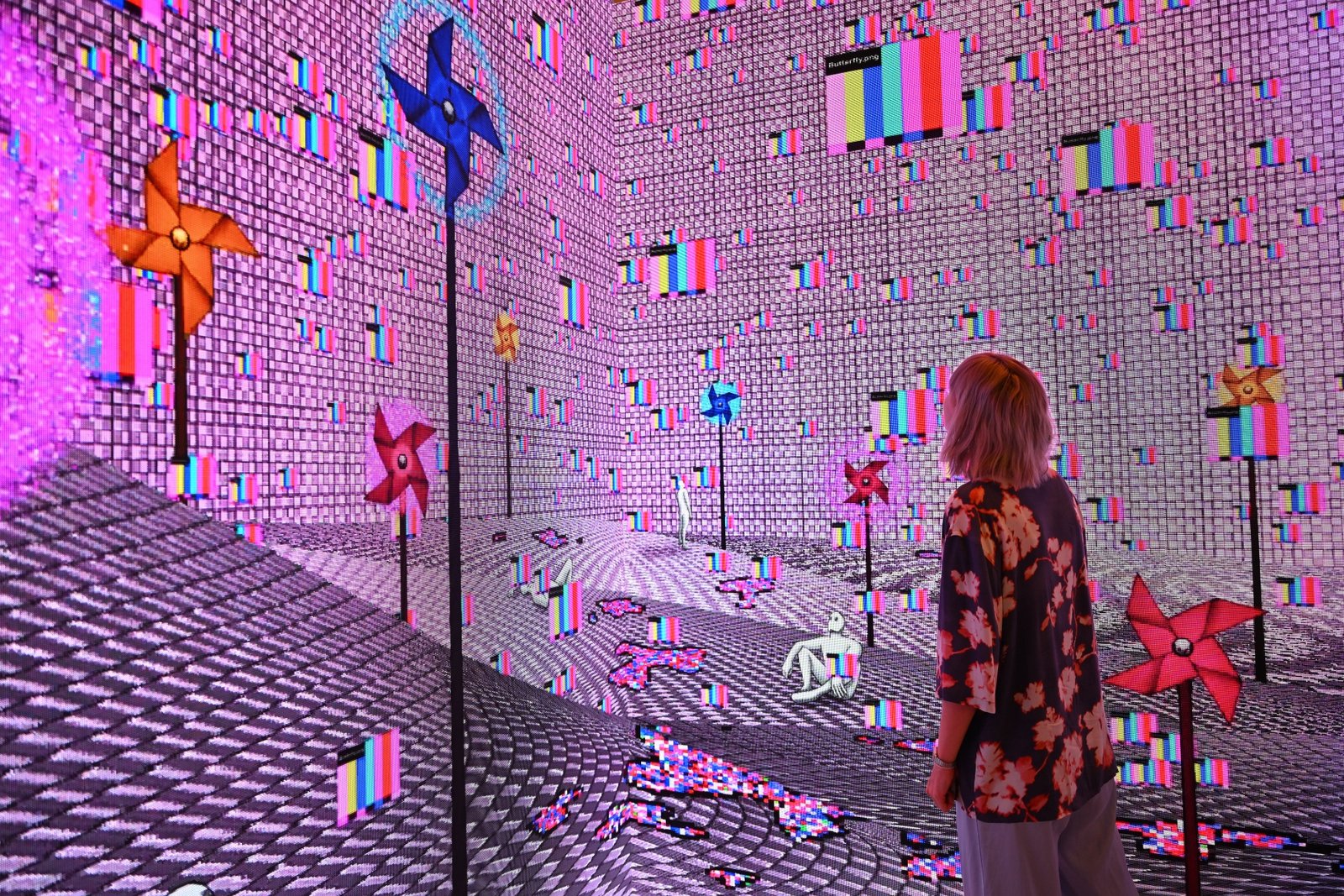
Ouchhh installation at Art Dubai 2025. Photo: Cedric Ribeiro, Getty Images for Art Dubai.
Capturing this wider audience’s attention and encouraging them to make the pilgrimage to Art Dubai Digital is the job of Gonzalo Herrero Delicado, the curator of this year’s edition. His chosen theme of “After the Technological Sublime” embraces the ambiguity of high-tech advancements that are both awe-inspiring and, sometimes, anxiety inducing. It also prompts viewers to appreciate digital art for its content rather than its form, as is second nature when contemplating traditional art.
The focus on medium of past editions, he believes, “created a distance, isolating digital art from the art world as something lesser.” By adapting the 17th-century Western philosophical concept of the sublime, however, “I wanted to readdress digital art towards the important questions that define our time.”
Compared to the NFT boom, “today we see more intentional collecting habits,” echoed Kenza Zouari of Hafez Gallery in Jeddah. “With buyers focusing on artistic quality and conceptual depth rather than just technological trends.” She also noted that the money being poured into regional institutions that in turn support ambitious digital art programs invites galleries to take risks on more experimental art.

Maryam Tariq’s site-specific installation for Art Dubai Digital 2025. Image courtesy of Hafez Gallery.
While Askarova believes digital art benefits from a physical component if it is to have wider appeal, Zouari has seen a growing interest in experiential work. She is meeting this demand by presenting through Art Dubai Digital an immersive installation by the Saudi artist Maryam Tariq. The work uses projection mapping to pull visitors into a story about memory and consciousness, with Zouari claiming that “collectors want experiences that engage multiple senses and invite reflection.”
Striking a more skeptical tone is Takwa Sabry of local Dubai gallery Mondoir, which will present paintings and sculptures by its founder, Amir Soleymani, as well as a collection of NFTs. “Dubai offers a unique convergence of art, technology, and global ambition,” she agreed, leading to growing interest in the region, “particularly among younger collectors who are digitally native and culturally open to innovation.”
She fears, however, that the path to enticing traditional collectors may be longer and more arduous than many in the digital art space are hoping. The category may even need a serious reputational rehaul before it is ready to compete with traditional art. “I see hesitation,” she cautioned. “Many traditional collectors are becoming more aware of the structural issues in digital art culture—the speculation, the lack of curation, the fleeting hype cycles.” Nonetheless, she praised Art Dubai Digital as an important “testing ground for ideas, even if the market itself isn’t mature yet.”
[ad_2]
Source link