[ad_1]
Coming off a triumphant anniversary sale season, which saw Heffel Fine Art Auction House achieve an industry rarity of 100 percent sold result, the Heffel Spring Auction is now on the horizon. Comprised of two sessions slated for May 21, 2026, Post-War & Contemporary Art will take place at 5 p.m. EDT followed by Old Master, Impressionist, & Modern Art at 7 p.m. EDT, the live sale will be held both in Toronto as well as in Heffel’s Digital Saleroom.
Together, the lots across both sessions reflect three centuries of Canadian and international art, and illuminate the pioneering and iconic work of artists across nations and continents.
“It is an incredible privilege to carry forward this special group of artworks that spans lifetimes and centuries,” says David Heffel. “These are works of exceptional quality and historical significance, and we are proud to bring them to market and share them with passionate collectors who will become part of their legacy.”
Below, we’ve parsed out just a few of the sales’ top lots.
Alexander Colville, Cattle Show (1955)

Alexander Colville, Cattle Show (1955). Est. $700,000–$900,000 CAD. Courtesy of Heffel.
While the work of Canadian painter and printmaker Alex Colville (1920–2013) is often categorized as Realist, the distinctive atmosphere and meticulous renderings that permeate his oeuvre bear more affinity to American Precisionism of the 1920s and ’30s. Predominantly painting on primed wooden panel, as in Cattle Show (1955), each composition is the result of a process comprised of sketching, studies, and live-model proportioning. Despite working decades earlier and focusing on scenes from everyday life, his work today often draws comparison to 2000s video game graphics, lending a simultaneously timeless and timely aesthetic to his paintings.
Jean Paul Riopelle, Sans titre (1950)

Jean Paul Riopelle, Sans titre (1950). Est. $1,000,000–$1,500,000 CAD. Courtesy of Heffel.
Considered one of the most important Canadian artists of the 20th century, Jean-Paul Riopelle (1923–2002) was a pivotal figure in not only bringing the Quebecoise art scene to international attention but also bringing the styles of the European avant-garde to Canada. Embracing total abstraction, he was one of sixteen cosigners of the Refus Global manifesto in 1948 alongside Paul-Émile Borduas and Françoise Sullivan, which took inspiration from French Surrealists and rejected the creative and social standards of Quebec of the time. His use of total abstraction—and at one point abandonment of the paintbrush in favor of the palette knife—resulted in paintings with a tactile and deeply emotive quality.
Guido Molinari, Structure rythmique vert-bleu (1966)

Guido Molinari, Structure rythmique vert-bleu (1966). Est. $200,000–$300,000 CAD. Courtesy of Heffel.
Canadian painter Guido Molinari (1933–2004) dedicated the period between 1963 and 1969 largely to his “striped” paintings, of which Structure rythmique vert-bleu (1966) is exemplary. Recognized for his serial explorations of color, geometric shape, and how the interactions between these elements created new and evolving perceptual spaces. This career period also proved pivotal for Molinari, as a year earlier he was included in the Influential “The Responsive Eye” exhibition at the Museum of Modern Art, New York, and the same year he was the recipient of the John Simon Guggenheim fellowship that allowed him to significantly expand his studio and thus the size of canvases he was able to work on.
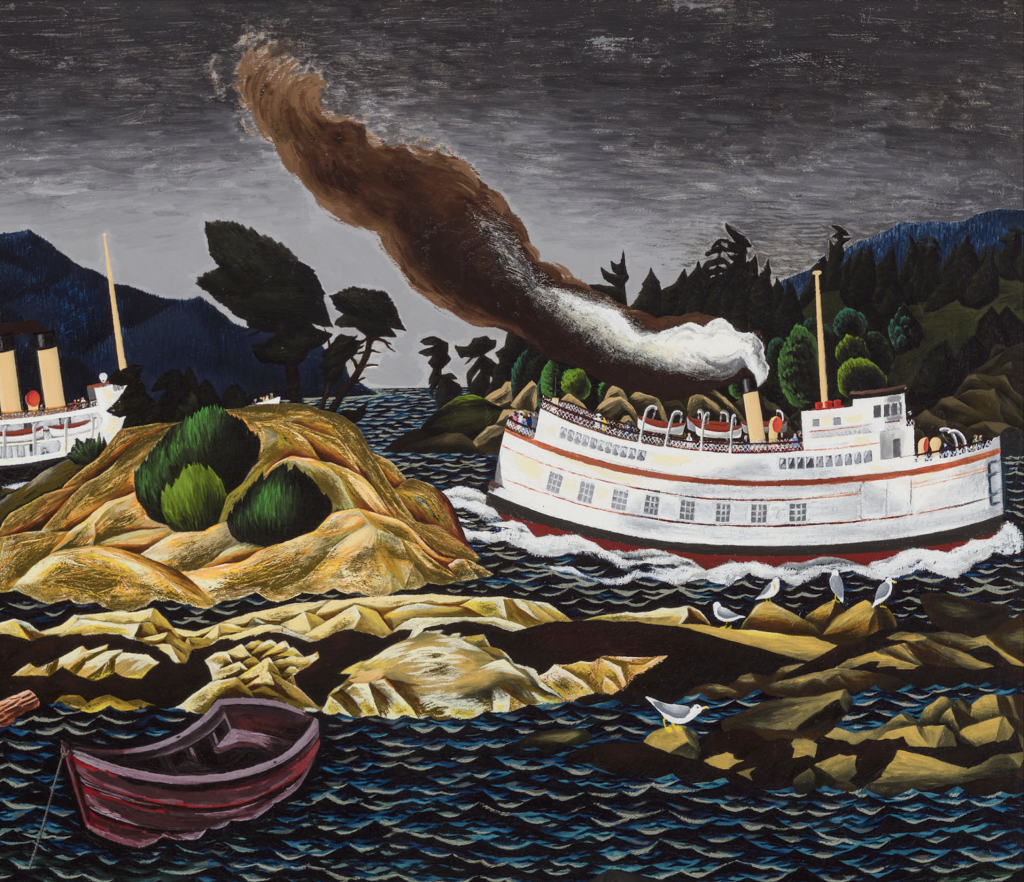
Edward John (E.J.) Hughes, Coastal Boats Near Sidney, BC (1948)

Edward John (E.J.) Hughes, Coastal Boats Near Sidney, BC (1948). Est. $1,250,000–$1,750,000 CAD. Courtesy of Heffel.
Serving in the mid-1940s as an Official Second World War artist for Canada, Edward John Hughes (1913–2007) is widely recognized for his distinct stylistic depictions of the landscapes of British Columbia. Brimming with movement and a unique sense of perspective, his bold compositions were influenced by a diverse set of art historical forerunners, from fellow Canadian painter Emily Carr to Mexican muralist Diego Rivera. Coastal Boats Near Sidney, BC (1948) is a consummate example of the artist’s primary source of inspiration, however, which was the natural world of land and sea around him.
Sir Peter Lely, His Royal Highness Prince Rupert (ca.1665)

Sir Peter Lely, His Royal Highness Prince Rupert (ca.1665). Est. $100,000–$150,000 CAD. Courtesy of Heffel.
Seventeenth century Dutch painter Sir Peter Lely (1618-1680) relocated to London in 1643, where he worked in the tradition of the Dutch baroque creating primarily mythological and religious scenes and other genre paintings. His portraits, however, quickly garnered widespread esteem. Following the death of Sir Anthony van Dyck, who had been the leading court painter in England at the time, Lely became one the most sought-after portraitists of the realm, and in 1661 was appointed the Principal Painter in Ordinary to King Charles II. A prolific painter, Lely produced thousands of portraits of some of era’s most influential personages, such as His Royal Highness Prince Rupert (ca. 1665).
Thomas John (Tom) Thomson, Early Winter Frost (1914)

Thomas John (Tom) Thomson, Early Winter Frost (1914). Est.$900,000–$1,200,000. Courtesy of Heffel.
Despite his comparatively short career, Thomas John Thomson (1877–1917), better known as Tom Thomson, created a prodigious body of work comprised predominantly of landscapes. Employing broad, impasto brushstrokes his paintings capture the emotional tenor of the natural landscapes of Canada take precedence over their exact representation. While his death preceded the establishment of the Group of Seven, formerly known as the Algonquin School, his work and practice nevertheless influenced their work significantly, with group member Lawren Harris describing Thomas as “part of the movement before we pinned a label on it.”
Heffel Spring Auction will be held May 21, 2026; Post-War & Contemporary Art at 5 p.m. EDT, Old Master, Impressionist, & Modern Art at 7 p.m. EDT.
[ad_2]
Source link