[ad_1]

W.E.B. Du Bois believed art divorced from social truth was no art at all. EuGene V Byrd III built an entire exhibition around proving him right.
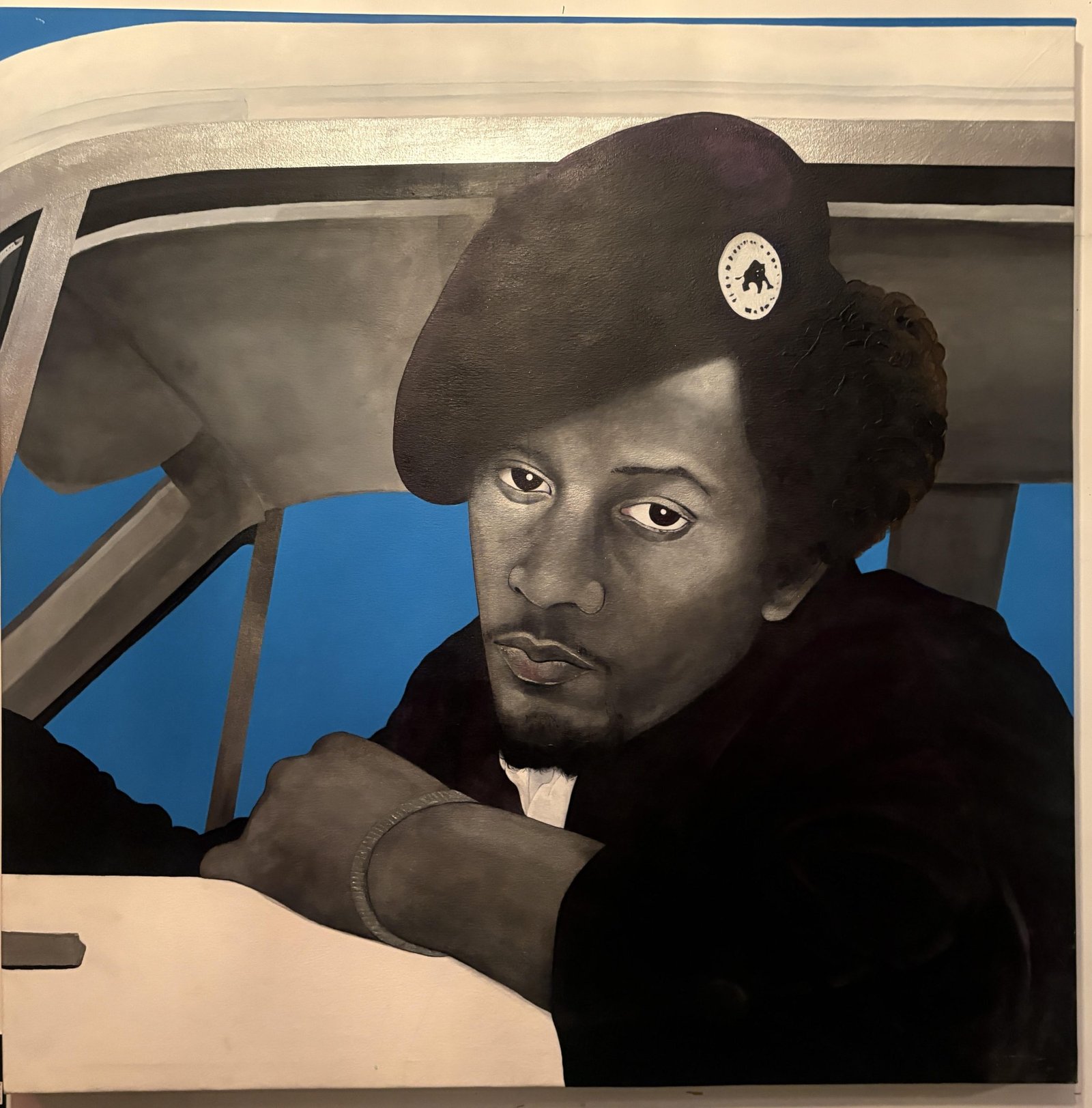
The “Politically inCorrect” group fine art exhibition opened Friday at Railroad ATL inside the Future Gallery at 255 Ted Turner Drive SW, bringing together more than 50 artists across painting, photography, sculpture, and collage to address what curator and founder Eugene V. Byrd III calls an overdue conversation.
“Right now, it’s like, when you think about 20 years from now, when people look at your body of work as an artist,” Byrd said. “What was I doing creatively? If I were just painting flowers, I feel like I would be doing a disservice.”
The show, which features an estimated 110 to 120 pieces, was born from what Byrd described as a growing silence among artists during a turbulent political period. Inspired by the W.E.B. Du Bois tradition of art as social responsibility, Byrd said he designed the open-call exhibition not to lead artists to any particular conclusion, but to ask a simple question: What do you have to say?
“It wasn’t leading them in any way,” he said. “It was just like, what do you got to say? Where do you stand?”

The show runs through May 30, when a closing reception and artist talk is scheduled from 5 to 10 p.m. The exhibition tagline, printed on its promotional material, reads: “Unfiltered. Uncensored. Unapologetic.”
Byrd himself, a direct descendant of Black Wall Street, traces his commitment to culturally rooted art back to his upbringing in the Midwest. Born in Wichita, Kansas, and raised with family ties to Tulsa, Oklahoma, he said places like Brown v. Board of Education’s Topeka and pre-Civil War “Bloody Kansas” shaped his artistic consciousness in ways he only came to fully understand as an adult.
“There’s a lot of Black history in the Midwest,” Byrd said. “You realize things when you get older, but it’s just always been there.”
He relocated the gallery in February after five years at Underground Atlanta, where he said a lack of institutional support for arts and culture programming ultimately made the move necessary. He launched the current space’s first exhibition in March and said the opportunity at the new establishment development renewed his sense of purpose in the city.
Among the artists featured is Faif Quin, whose single-piece contribution, “The Americans Dilemma, Part Four: The Ballad of Chuck’s Rec Wheel, We Are Gathered Here Today,” generated immediate conversation at the opening. The large-format photograph depicts a group of diverse individuals, wearing blindfolds and dressed as though attending a funeral, gathered around frames with withered flowers and mirrors.
Quin said the piece was prompted by the September 2025 killing of conservative commentator Charlie Kirk and what followed.
“Shortly thereafter, violence against Black people spiked,” Quin said. “I’m not a political analyst, but I’m not crazy to relate the two.”
The blindfolds, Quin explained, were intentional, meant to invite the viewer to step into the image rather than simply observe it.
“I wanted to remove their eyes because I feel like eyes represent the soul,” Quin said. “I wanted the audience to be the eyes.”
Brooklyn-born painter Naylon D. Mitchell, who has called Atlanta home for the past 30 years, displayed a piece titled “Mama Rosa,” a portrait drawn from a photograph he encountered on social media depicting a Cuban woman. Mitchell, who has also worked as an actor since age 17, said he paints from photographs with the intention of leaving interpretation open.
“It could be interpreted so many different ways,” Mitchell said. “You can kind of fill in the blanks yourself.”

Timothy LaGrone, a Grand Rapids, Michigan native who has lived in Atlanta since 2003, contributed a colored pencil work titled “Veins of Diaspora,” in which a figure is depicted wrapped in both an American flag and an African flag, with visible markings on his body representing, in LaGrone’s words, what Black Americans endured over the past 400 years.
“Things haven’t really changed much,” LaGrone said. “The current administration is trying to turn the clock back and ignore the history that we’ve gone through.”
For Byrd, the artists showing at the exhibition, including some whose galleries have declined to exhibit politically charged work, represent a kind of cultural resistance he hopes viewers carry with them after leaving.
“I want people to leave with some optimism, for sure, some hope,” he said. “To know that there is some resistance to what’s going on, that there is a shift that could be happening, and it can start with the arts.”
Related
[ad_2]
Source link