[ad_1]
The latest exhibition at the Walker Art Center, co-organized by the museum and the Whitney Museum of American Art, surveys the last 15 years of the artist Christine Sun Kim, challenging cultural assumptions about the value of spoken communication over signed language. In All Day All Night, the Berlin-based artist, who is deaf and whose work has been featured in institutions from the Smithsonian American Art Museum to the Museum of Modern Art, reworks the meaning of sound and language through her vast artistic mediums that include drawings, videos, and participatory pieces. The exhibition, on view until Aug. 30, includes art created as far back as 2011, but it all relates to Deaf culture and the human experience. The intricate world Kim has crafted examines what we think we know about sound and language.
The Walker Art Center has exhibited Kim’s work in three galleries, all of which are separated chronologically. The work goes beyond framed pictures, with charcoal music notes spanning the floors and stairwells, making black and white patterns everywhere you turn. The color choice was simple: black and white is direct.
Much of the art in the first gallery holds Kim’s early work from the 2010s, drawn with charcoal and encompassing the humor and realities experienced by deaf and hearing people. The first pieces visitors meet are a big, upside-down U titled All. Day., in reference to the American Sign Language sign for the phrase. Beside it is her sister piece inked in red, All. Night., a right-side up U to correspond with its sign.
It is also the start of Kim’s many experiments with sound waves through audio equipment, ink, and canvas, using different vibrations from speaks to cast different movements, and rewriting a whole new definition of sound. When Kim started experimenting with sound, she started noticing her physical and mental health was being affected by the constant feedback she would play with. Sound came to affect her physically even when she couldn’t hear it, giving the name Feedback Aftermath. Since then, Kim has been interested in the concept of music.
“When I first started working with sound, I didn’t really have any frame of reference; I didn’t have a mentor, and I had to start from the very beginning,” said Kim in ASL, translated by an interpreter. “Now, I think I’m at a point where I can play around with grammar, and I’ve developed my own vocabulary, if you will. Now, I’m taking it to the next level. Now, I’m starting to tell stories.”
In the second gallery, worlds begin to intermingle as Kim began to incorporate her experiences with her partner and children. In some ways, her daughter Roux is featured in curated lullabies from when she was a baby. Others offer a glimpse into life as both a mother and artist where in the corner of a canvas, there’s scribbles of Roux replicating drawings.
Kim experienced pushback from museums on accessibility provisions. Those feelings and memories came through in anxiety dreams, where she got the idea for an all-black mural sprinkled with white U shapes. In ASL, the sign for “dream” involves taking your dominant pointer finger to your temple, and pulling the finger up and away from your head while going between bending and straightening. If the sign were to be drawn, it’d look like the letter U, which adds a dimension to the sign in her artwork Unfortunately, We Cannot.
Kim incorporates infographics in her work, a medium she picked up while studying graphic design. Pie charts and Venn diagrams are a common feature in the gallery, as Kim uses them to document things like: Why My Hearing Partner Signs and When I Play the Deaf Card.
“I realized if you give an idea the right shape and put it in the right place, the information becomes clear,” Kim said. “If you put it in the wrong place, it’s not clear. Thinking about clarity and avoiding misunderstandings has definitely impacted my practice.”
Her art can display lighthearted humor while also showcasing real-life moments that answer people’s questions about her life in a hearing-centered world. Kim compares the infographics to body language and text, where the two rest at a middle ground between sign language and spoken English.
The third and final gallery is where much of Kim’s other mediums start to appear. From a room with a rock and two air-filled hands to a colorful bench that visitors may overlook, Kim utilizes this space to showcase her life from 2020 and onward. Her time at the 2020 Super Bowl, signing the national anthem and “America the Beautiful” in ASL, was cut short by the cameras broadcasting to TV channels for Deaf people.
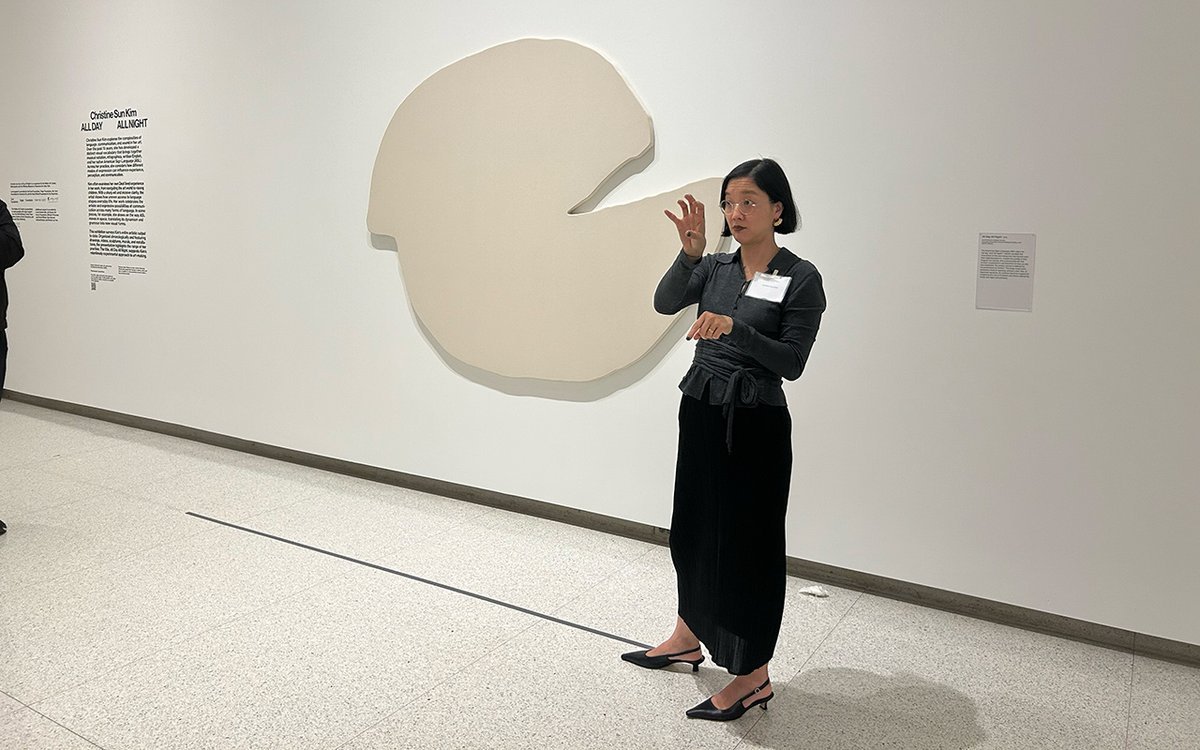
Just like the start, the exhibition ends with All Day All Night, a combination of the two separated pieces from before, now joined under a new medium as a sculpture, but still encompassing the passing of time and the cycle of change awaiting Kim.
[ad_2]
Source link