
[ad_1]
- Austrian billionaire Klemens Hallmann is being forced to sell his 32 percent stake in Niclas Castello’s $23 million gold cube sculpture amid bankruptcy proceedings.
- The 400-pound, 24-karat artwork went viral after a 2022 Central Park debut and was tied to the launch of a crypto token and NFT platform.
- Originally described as “not for sale,” the cube is now entangled in financial fallout, raising questions about art’s intersection with speculation and hype.
A glittering conceptual artwork made of gold that went viral in 2022 may soon be partially up for grabs, as an insolvent Austrian real estate tycoon prepares to sell his stake in the 400-pound Castello Cube.
Valued at approximately $23 million based on current gold prices, the hollow 24-karat gold sculpture by German artist Niclas Castello has sat at the fraught intersection of art and finance since its inception more than three years ago. Now, as Austrian billionaire Klemens Hallmann’s financial empire collapses, his 32 percent stake in the cube is being turned over to creditors, according to debt collection agency Creditreform. It’s transforming the work from a symbol of crypto-era speculation into an object lesson in liquidation.
The cube became an internet sensation in February 2022 when it was left in New York’s Central Park for a day—with a heavy security detail. Hallmann was among the visitors who trekked to the park to see it. At the time, the artwork was never intended to be sold, according to Castello’s website, which stated that the work would “never be sold or owned.” Instead, it was used to garner attention for an accompanying crypto token and an associated NFT platform launched by the artist. Swiftly thereafter, it appeared in Venice and again Zurich.

Artist Niclas Castello, left, with film producer and entrepreneur Klemens Hallmann, center, and founder/ CMO of Castello Coin Sven Wenzel pose for the debut of “Castello Cube,” an artwork made of pure 24-karat, 999.9 fine gold in Central Park on February 2, 2022 in New York City. Photo: Cindy Ord/ Getty Images.
Hallmann, who built his financial empire investing across film, real estate, and other industries, was worth an estimated $1.9 billion in 2023. He filed for personal bankruptcy in August, citing a downturn in the property market. He is offering his creditors a 30 percent dividend, payable within two years.
Earlier this year, his property development firm SÜBA AG also fell into insolvency and is now being liquidated after failing to meet a payment deadline tied to its restructuring plan, according to Bloomberg.
“I will continue to work with full transparency, reliability and consistency on implementing the approved restructuring plan,” Hallmann said in a statement on October 28. It is unclear how how the sales process would work, or how the stake sale will be impacted by its ownership structure.
Castello did not respond to a request for comment on the sale of the investor’s stake in his artwork or when the artwork had been sold in part to Hallmann.
Why the Castello Cube Went Viral
On February 2, 2022, early morning Central Park visitors came across a curious sight: A cube composed of 186 kilograms (around 400 pounds) of pure 24-karat gold that was wheeled out to the Naumburg Bandshell at around 5 a.m. Conceived by the German artist Niclas Castello, he billed it as a conceptual “socle du monde” (base of the world) sculpture for our time. Flanked by a private security detail, the work was displayed in the park until the day’s end. Later that same night, it was carted off to a private dinner on Wall Street, where numerous celebrities were said to be in attendance.
In a message sent to Artnet News, Castello called the work “a conceptual work of art in all its facets.” He said the idea was to “create something that is beyond our world—that is intangible.”
Based on the price of gold at the time, $1,788 per ounce, it was said to be worth around $11.7 million. But the artist didn’t want to sell it. Instead it was proof of concept for his accompanying cryptocurrency that was being launched alongside the physical artwork. The Castello Coin, traded as $CAST, was available for purchase online at an initial price of €0.39 ($0.44) each, with an accompanying NFT auction scheduled for 21 February.
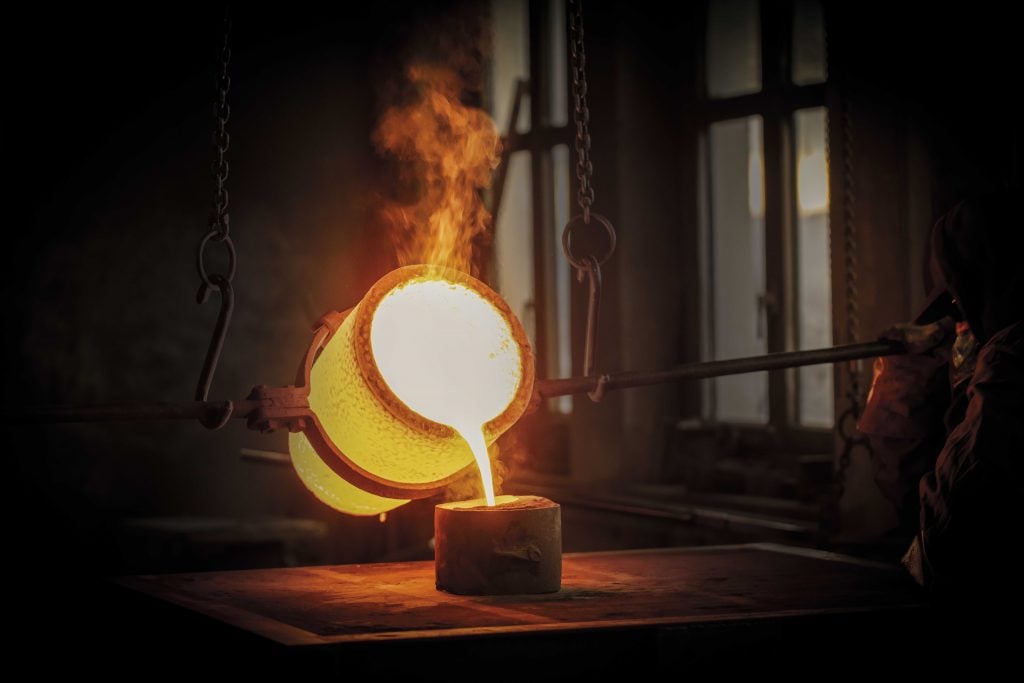
The Castello Cube being cast in a foundry in Switzerland.
“The cube can be seen as a sort of communiqué between an emerging 21st-century cultural ecosystem based on crypto and the ancient world where gold reigned supreme,” said the Viennese gallerist Lisa Kandlhofer, who was in New York for the artwork’s launch.
It’s unusual presentation made it a meme sensation after its 12-hour public display, eventually leading to a skit on the Daily Show with Trevor Noah.
For the art world, then in the throes of NFT mania, it became a cipher for how financially orientated some art—and its collectors—had become. The cube was “an uneasy reminder of just how financialized contemporary art has become,” one-time art-world meme-maker Jerry Gogosian told Artnet News in April 2022.
How the Cube Was Made
According to Castello’s team, the golden cube was cast at a foundry in Aarau, Switzerland, requiring a special handmade kiln in order to withstand both the sheer size and volume of gold, as well as the extreme temperatures needed to melt it, reaching up to 1100 degrees Celsius. The cube measures over a foot and a half on all sides and has a wall thickness of about a quarter inch.
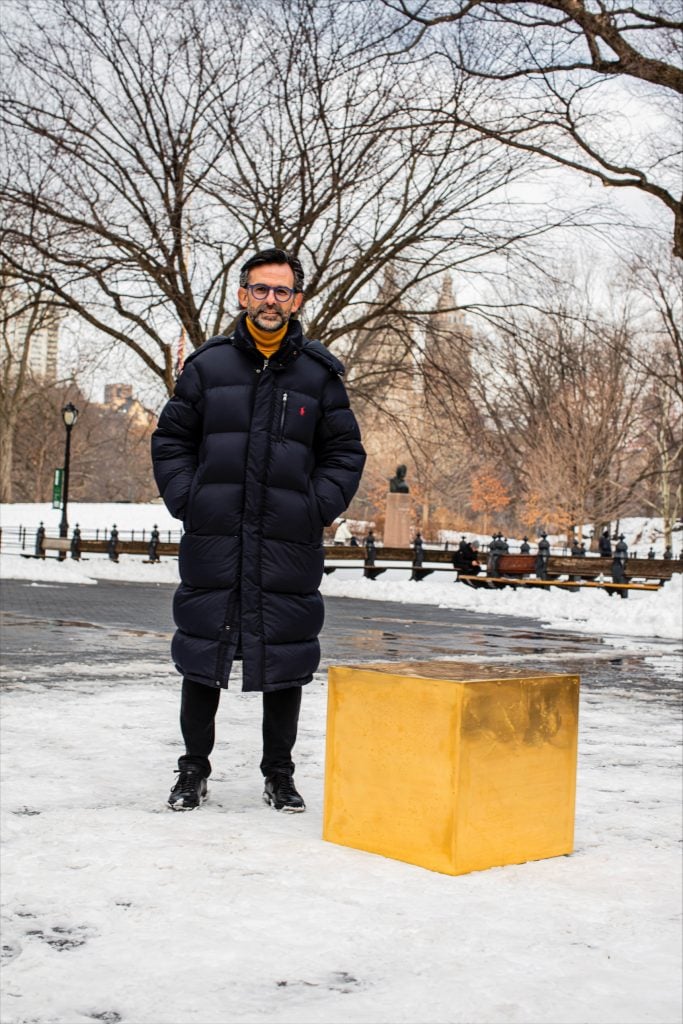
Niclas Castello with his piece The Castello Cube in Central Park, New York. Photo by Sandra Mika.
Born in 1978 in East Germany, Castello currently lives between New York and Switzerland, and is known largely for his sculptures and paintings partly inspired by artists like Jean-Michel Basquiat and Andy Warhol. Castello’s previous works lean heavily on imagery from pop and consumer culture.
Comparisons by many were drawn between Castello’s cube and Damien Hirst’s infamous diamond encrusted skull, a memento mori that is also a commentary on art’s endless entanglement in money and capital, or Piero Manzoni’s tongue-in-cheek provocation Artist’s Shit (1961), a tin can containing the artist’s feces which he sold for its weight in gold.
Dorian Batycka contributed reporting.
This story was originally published on February 2, 2022. It was updated on November 3, 2025 to reflect the sale of Klemens Hallmann’s stake in the artwork.
[ad_2]
Source link