[ad_1]


Published 15th Feb 2026, 00:00 GMT
Working with the gallery’s curators, Gosney has selected works across the decades of his artistic practice. The show features a range of his sculptural works and explores the artist’s experimentation with various materials including different types of wood and metal. “There are certain pieces that during my career I felt I had arrived at a certain point where I had success in what I was trying to do,” says Gosney. “There are some that I feel I kind of achieved something that I had been aiming at for some time.”
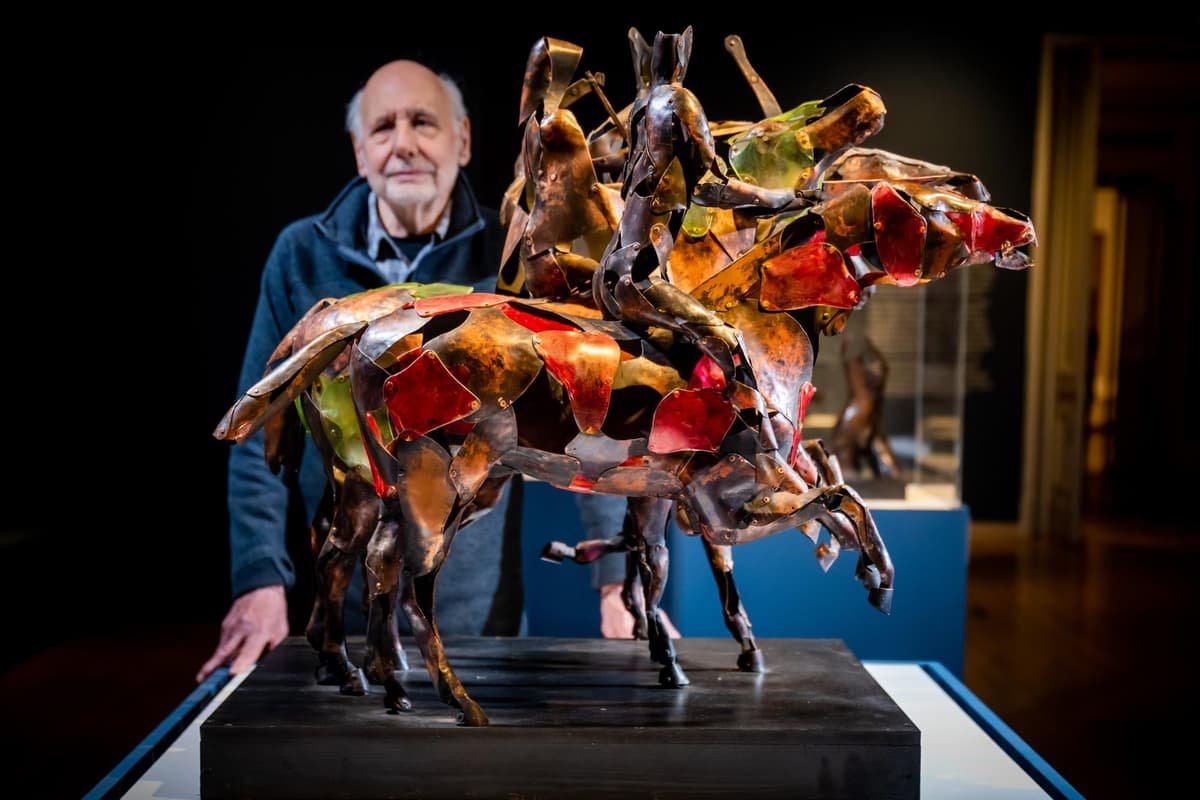
Highlights of the exhibition include his striking piece Four Horsemen of the Apocalypse, crafted from copper and Perspex, the powerful and moving Father and Son, Bam inspired by a shocking newspaper image of a father cradling his dead child after the catastrophic 2003 earthquake in southern Iran, and the playful and stylized Jazzman, a portrait of a sax player skillfully carved from a single block of sycamore wood, and a trio of drawings depicting views of the nearby York Museum Gardens. Gosney has been based in York since the mid-1990s and several of the works in the exhibition have been at the gallery as part of its collection for some years, but many others have never previously been shown anywhere including a range of early works and some made in the last few years.
The exhibition also focuses on the importance of drawing in Gosney’s creative practice. He makes preparatory drawings before he begins a sculpture, but also during the making of it he often draws, to try out where the material might take him. Many of Gosney’s preparatory and working drawings, relating to works in the show, are also on display in the gallery space. While the works are in some cases stylized, verging on abstraction, they are mostly figurative. “When I first started, I made quite a few abstract pieces but my interest lies really in drawing and observation,” he says. “I found the challenge of making shapes based on the animal and human form really interesting and I particularly like the challenge of working in three dimensions, so sculpture has been the main focus of my work over the years.”

Gosney, who grew up in Grimsby, says he had an interest in art and drawing from an early age. “You used to be able to get a sketching permit for the docks and as a youngster I would go down there to draw. At that time Grimsby was a very busy fishing port so there was so much to observe and make sketches of. When I got home, I would then make little models too – my dad was a lathe worker and he had tools that I could use.”
Neither of his parents had an arts background but both were very supportive of his wish to pursue his studies in art. “I was expected to go into the sixth form at grammar school, but I wanted to go to art college; I clearly remember my dad saying to me ‘I don’t mind what tha’ does lad, as long as you enjoy yourself’,” he says. He got a place at Grimsby School of Art and after completing the foundation course between the ages of 16 and 18, he went on to study at the Slade School of Art in London. It was quite a culture shock at first. “I had only ever been to London once before and there were only about three of four of us from the North of England at the Slade at that time. And I was very young.” But he soon settled in and did very well – he won several awards including the life-drawing prize and went on to do an MA there in Theatre Design. “I didn’t do any sculpture at the Slade – I studied painting, but while I was doing my MA, I designed and made sets, which I really enjoyed and I suppose that’s where I first started doing things in 3D and became increasingly interested in that.”
Alongside his creative practice, Gosney had a long career in teaching. Although he was offered work in theatre after leaving the Slade, he decided instead to take up a teaching post at Grimsby College of Art where he had been a student in the 1950s. He remained there until his retirement. “I continued with my own work throughout my teaching career, I would do commissions at weekends and during the holidays. I think my creative practice and my teaching definitely complemented each other and fed into each other. We were lucky to have a head of department who actively encouraged us to keep doing our own work, he could see the value in that for the students.”
A sprightly octogenarian – he turns 90 next year – he shows little sign of slowing down. His creative drive continues and he still goes to work in his studio most days. “I sometimes have several ideas on the go and I do get up early and go to bed early. I like to get to my studio around 8am if I can, these days I start to get a bit tired by early afternoon. Wood carving is quite strenuous and I get back ache and arm ache which I didn’t used to, but that is to do with getting older. I usually finish around 3pm, go back to my apartment and draw or do some pen and ink illustrations for a book for a walking group I have been working with recently. I can’t wait to get the day going and start work on something. I’m very happy that I still feel that way; I am lucky I still have that interest.”
Harold Gosney: Materials and Making is at York Gallery until June 28.
[ad_2]
Source link